


Renewing Spain's Digital Nomad Residence Permit: the New, Simpler Document List
From 1 July 2026, renewing Spain's Digital Nomad residence permit is simpler. What casilla 171 in your renta (Modelo 100) must show, when to apply, the visa-D vs renewal distinction, what to do if income fell short, and the autónomo timing rule.

The gist in a minute
News: as of 1 July 2026, the document checklist for renewing your Digital Nomad residence permit in Spain has changed — and it is now significantly simpler. This is first-hand information: our agency was personally present at a meeting in Asturias with Luis Esteban-Manzanares Fernández-Roldán, an Area Coordinator at UGE (Unidad de Grandes Empresas y Colectivos Estratégicos) — the unit that processes residence applications under Law 14/2013, including digital nomad permits.
The core of it: fewer documents overall, but one item remains decisive — your last two annual income tax returns (renta, Modelo 100), with the income in casilla 171 meeting the nomad threshold. Let's break it down. Preparing for an initial application rather than a renewal? Start with our Digital Nomad residence guide. The maintained, non-dated version of this checklist lives in our Digital Nomad renewal guide.
The new document checklist for renewal
When renewing your Digital Nomad residence permit, you now need:
1. Valid passport or ID document
As always: a current passport, plus any valid document identifying you in Spain if you hold one.
2. Current work contract with traducción jurada (sworn translation)
Key point: the contract must be active. If the original work contract you used for your initial permit is still in force, you reuse it — no new contract is needed. Any contract not in Spanish must come with a traducción jurada (sworn translation).
About the translation: first make sure the contract stays valid for the full renewal period — roughly 2 more years — and only then order the traducción jurada. There is no point paying for a sworn translation of a contract that is about to expire. If the contract has been re-signed or replaced, submit the current version with its sworn translation.
3. Application forms and government fee
The standard part of any residence renewal: completed application forms and the paid government fee. The only thing that matters here is that your data (address, contact details) is current.
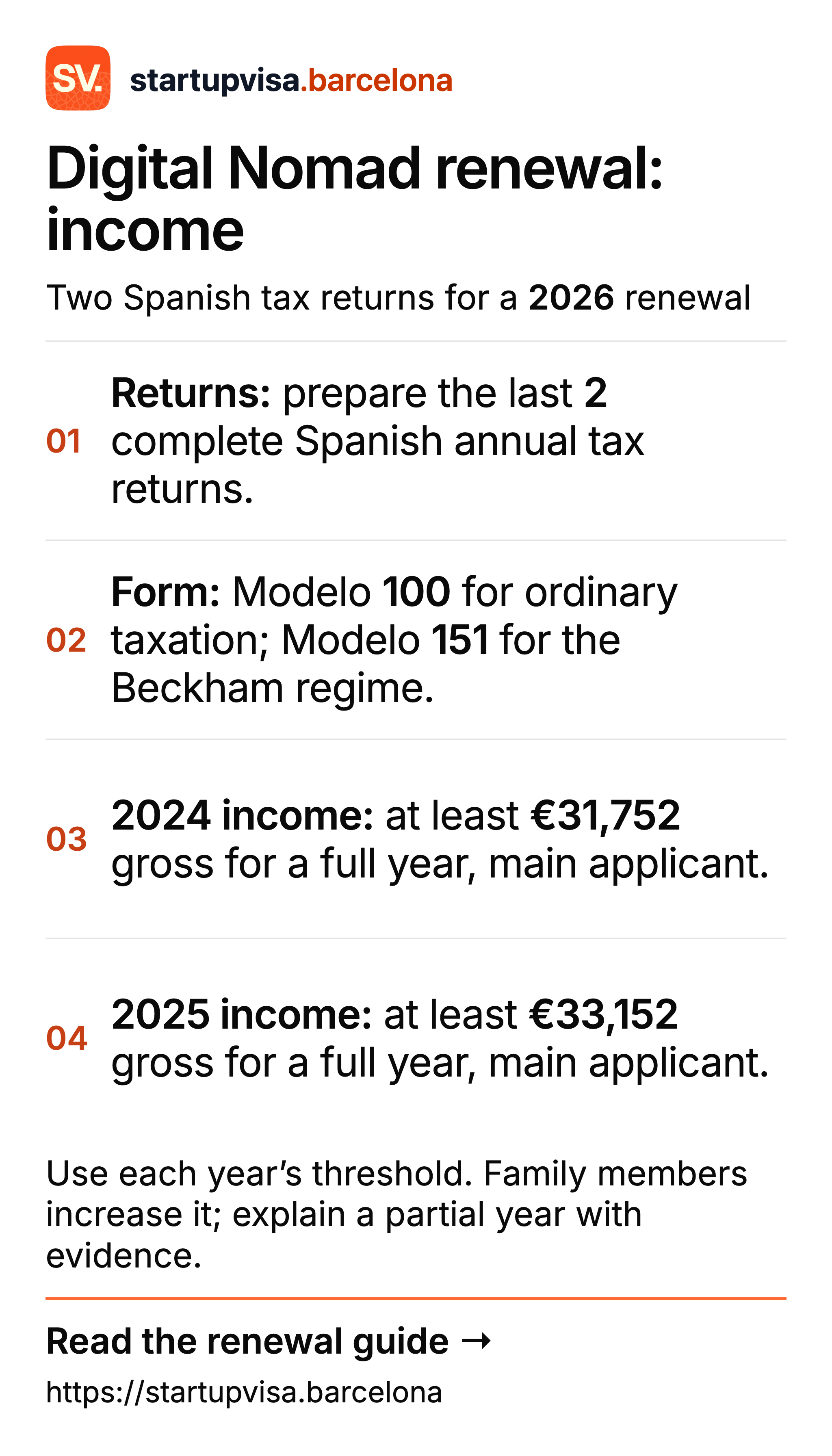
4. Your last two tax returns: renta (Modelo 100)
This is the most important item. UGE asks for your last two annual income tax returns — renta, form Modelo 100 — filed with the Spanish tax authority (Agencia Tributaria).
The critical field is casilla 171: the annual income it shows must be at or above the Digital Nomad minimum threshold for that tax year. Each year's return is checked against that year's threshold.
2026 reference figures:
- Minimum nomad income: €2,849 per month (200% of SMI), i.e. €34,188 per year
- SMI (Salario Mínimo Interprofesional) for 2026: €17,094 per year
On the Beckham tax regime? Then your annual return is filed on Modelo 151 (not Modelo 100) — but the principle is the same: you still have to show stable income at or above the threshold. More in our Beckham Law tax regime guide.
You can sanity-check your numbers against the current requirements with our income calculator.
When to apply: timing and the crucial visa-D distinction
Processing time. UGE typically resolves a renewal in about 20 working days. If no decision arrives in time, Law 14/2013 provides for positive administrative silence (silencio positivo) — silence is read in your favor. Your residence remains valid while the application is under review.
When to file (for TIE card holders). You can file the renewal up to 60 days before your residence card expires and for up to 90 days after it expires (a grace period). Do not leave it to the last day.
⚠️ Important: a renewal is not an initial application. If you are in Spain on a national type-D visa (a visado issued by a consulate), your next application is not a renewal (renovación) but an initial residence application (inicial) filed inside Spain. The "60 days before / 90 days after" rule does not apply here: you must file while the D visa is still valid — there is no grace period once it expires. Do not let the D visa lapse before filing, or you will have to start over. Not sure whether you hold a D visa or a TIE card? Talk to us and we will sort out your situation.
Check your own filing window
Enter your expiry date to see which rules apply to you.
Which document do you currently hold?
Everything is calculated in your browser. Your date is never uploaded or stored.
General information, not legal advice. Check both the date and the document type — a visa expiry and a TIE expiry are not the same thing.
Your filing window
- Window opens
- Document expires
- Late filing limit
No renewal decision after 20 working days?
If the legal decision period has passed without an express notification, check whether silencio administrativo positivo applies before treating the case as an ordinary delay. Suspensions and public holidays matter, and each family member has an individual registration number.
Read our guide to the 20-working-day rule and the official UGE filing route, then use the free silencio positivo PDF generator to prepare a Spanish request privately in your browser.
What to do if your income was below the threshold
This is not a blocker for renewal. We have handled these cases before and know the playbook.
What we do:
- Draft a supporting letter in your name explaining why the declared income fell short — for example, you received your permit late in the year and worked only part of it
- Demonstrate the required level of savings (bank statements, proof of assets) to close the income gap and show financial stability
- Where useful, add employer letters confirming stable employment
The result: in our practice these cases get approved when the supporting evidence is solid. The key is not to hide the gap but to explain it and back it with alternative proof of financial capacity.
Tip: if you already know your income falls short of the threshold, contact us before filing — we will prepare the compensating documents in advance.
Special case: self-employed (autónomo) nomads
If your nomad permit runs through autónomo (self-employed) status, there is one critical point.
Your autónomo registration must have been done on time. The working reference is a window of roughly 45–60 days after your permit was approved.
If registration was late or never happened — expect questions from UGE at renewal, and do not file as-is: you will need a different documentation tactic.
Our advice: not yet registered with RETA (the Spanish social security scheme for the self-employed)? Do it now — it takes days, not weeks, and saves you real trouble at renewal. If you registered late or not quite by the book, talk to us before filing and we will work out the right tactic. And for what documents prove self-employed status in the first place, see our guide to self-employment certificates. Update, September 2026: UGE now asks for a RETA alta from the day after approval; back-dating an existing alta is currently impossible because Seguridad Social pauses such requests pending verification — see the renewal guide for the options that remain.
Action checklist before submission
Your pre-renewal checklist:
- Check that your passport is valid for at least the full renewal period
- Confirm your work contract is still in force (and still covers roughly 2 more years); if yes, reuse it
- Order a traducción jurada (sworn translation) of the contract from a certified translator — after confirming it will not expire soon (if it is not in Spanish)
- Download your last two Modelo 100 returns (or Modelo 151 on the Beckham regime) from Agencia Tributaria
- Check casilla 171 in both: income must be at or above that year's threshold; if it is below, gather savings statements in advance and contact us
- If you are autónomo — confirm your RETA registration is active and was done on time
- Identify your scenario: a TIE renewal (the "60 days before / 90 days after" window) or an initial application on a D visa (file before it expires)
- Fill out the renewal forms with current data and pay the government fee
For the full document list, see our Digital Nomad residence permit guide. To test your numbers against the 2026 requirements, use the income calculator.
Based on our meeting with a UGE Area Coordinator in Asturias on 22 July 2026; autónomo note updated 2 September 2026.
For a renewal we read casilla 171 in both of your Modelo 100 returns against the threshold for each year, file inside your 60-days-before or 90-days-after window, and then handle everything UGE asks for until the resolution.
Calculate your 2026 Digital Nomad income threshold
Use the SMI-based calculator before collecting bank statements, salary letters, and family documents.
Open income calculatorEstimate whether Beckham Law is worth it
Compare the 24% special regime with a rough regular IRPF estimate and see where the saving becomes material.
Open Beckham calculator