


📅 Reviewed: 1 September 2026
💰 24% flat tax for qualifying new residents — for up to 6 yearsBeckham Law Tax Regime Spain
Spain can tax qualifying new residents at 24% instead of progressive rates up to 47%. The statutory work or entrepreneurial route matters; the residence permit alone does not decide eligibility.
Key facts about the Beckham Law
- Tax Rate
- 24% flat rate (vs up to 47% regular)
- Duration
- 5 + 1 years (year of move + 5 full years)
- Income Limit
- €600,000/year (excess taxed at 47%)
- Capital Gains (Spain)
- 19-30% (foreign gains exempt)
What is the Beckham Law?
The Beckham Law (Régimen Especial de Trabajadores Desplazados, LIRPF Art. 93) lets qualifying new Spanish tax residents pay tax as non-residents for up to 6 years. Spanish-source income is taxed at a flat 24% instead of Spain's progressive rates of up to 47%.
- Employment income from Spanish companies
- Income from the permitted economic activities in art. 93.1.b).3.º and 4.º
- Director/administrator fees from Spanish companies
- Economic activity income from Spain
- Foreign dividends and interest
- Foreign rental income
- Capital gains from assets outside Spain
- Inheritance and gifts from abroad
Who can apply for the Beckham Law?
You must meet all three requirements to qualify
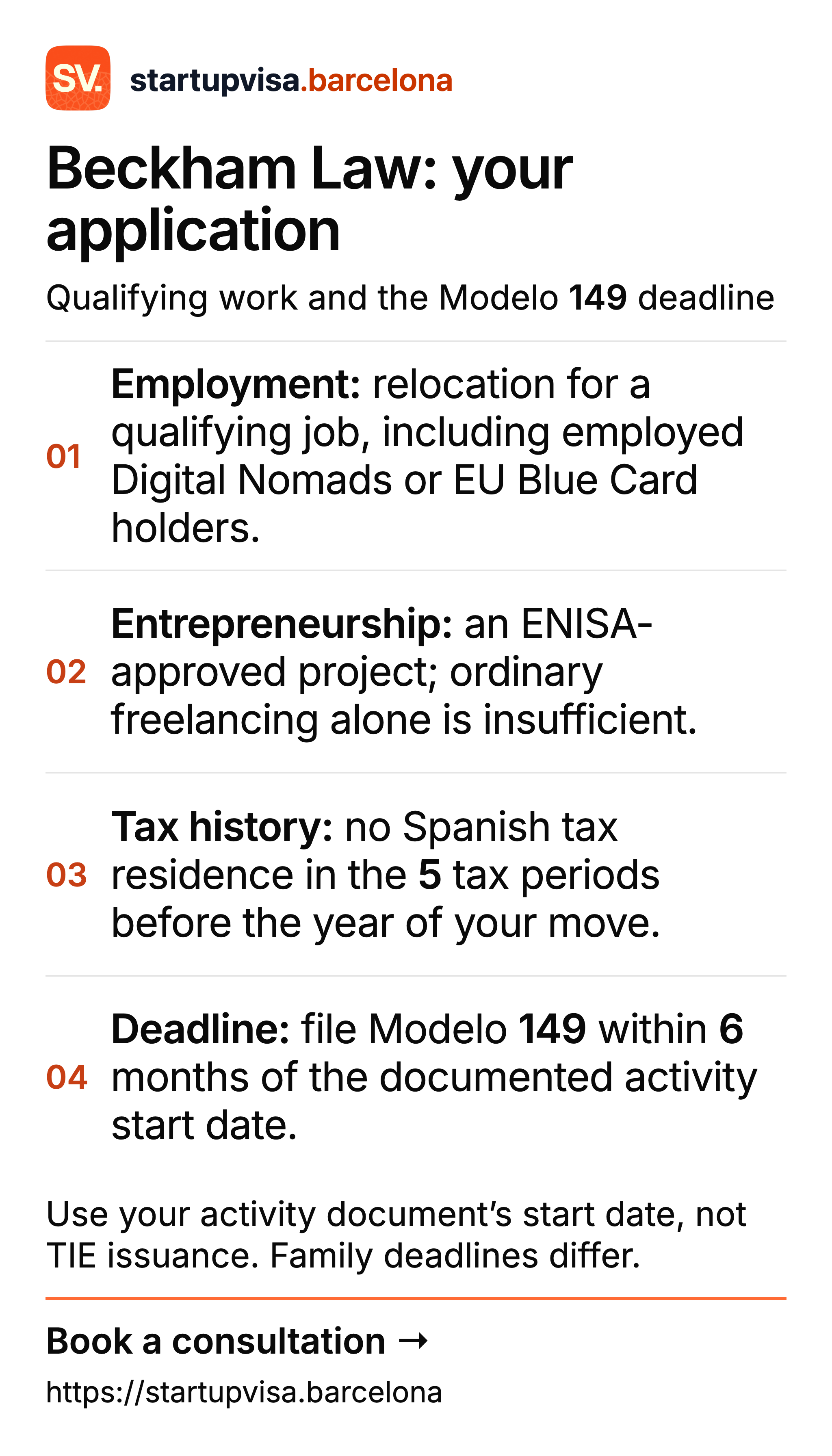
- You were not a Spanish tax resident in the 5 years before arrival
- Your move to Spain is linked to your visa or work — the causal connection most refusals turn on
- You do not earn income through a permanent establishment in Spain (with some exceptions)
Digital Nomad (Employed)
You need an employment contract with a foreign company that has a Spanish presence or registers you locally
Learn moreDigital Nomad (Autónomo Profesional)
Self-employed freelancers who invoice clients directly are not eligible
Startup Visa (Emprendedores)
Recognised entrepreneurial activity with the favourable report under Law 14/2013 art. 70; this tax route does not itself require an SL
Learn moreHighly Qualified Professional
Your Spanish employer registers you in the SEPE catalogue of companies
SL Administrator
Article 93.1.b).2.º sets no shareholding cap for administrators. A 25% limit applies only where the company is an asset-holding entity
Beckham Law vs regular tax: the rates
How the 24% flat rate compares with the progressive IRPF scale
- €0 - €600,000 → 24%
- Above €600,000 → 47%
- €0 - €12,450 → 19%
- €12,450 - €20,200 → 24%
- €20,200 - €35,200 → 30%
- €35,200 - €60,000 → 37%
- €60,000 - €300,000 → 45%
- Above €300,000 → 47%
Example: on €100,000 of income, the Beckham Law saves about €12,000-15,000 a year compared with regular taxation
How capital gains are taxed
Spanish assets are taxed; foreign assets are not
Gains from selling Spanish property or shares in Spanish companies are taxed at progressive rates: 19% (up to €6,000), 21% (€6,000-50,000), 23% (€50,000-200,000), 27% (€200,000-300,000) and 30% (above €300,000)
Gains on assets outside Spain — foreign stocks, crypto, property abroad — are exempt from Spanish tax under the Beckham Law
No foreign asset declaration required
Beckham Law beneficiaries are exempt from filing Modelo 720
Regular Spanish tax residents must declare all foreign assets worth over €50,000 — bank accounts, securities, property, crypto — on Modelo 720. Penalties for errors or late filing are severe. Under the Beckham Law this duty does not apply: your foreign assets stay unreported to the Spanish tax authority.
How to apply for the Beckham Law
You apply online with Modelo 149 — here is each step
Choose an accepted identification method
AEAT accepts DNIe, an electronic certificate or Cl@ve PIN for the online procedureOpen Modelo 149
Go to the Agencia Tributaria website and open the Modelo 149 formFill in the form
Enter your personal data and visa details, then tick the checkbox that matches your situationAttach documents
Upload the visa approval (resolución favorable), your RETA registration and Form 036 if it appliesSubmit online
Confirm with your chosen accepted identification method and submit — no office visit neededWait for approval
AEAT states a 10-working-day resolution period. You can check the status online
Casilla 54 — Actividad emprendedoraCasilla 43 — Trabajador por cuenta ajenaCasilla 43 — Trabajador por cuenta ajenaCasilla 45 — Administrador de entidad- Passport copy
- Visa/residence permit approval (resolución favorable)
- NIE certificate
- Social Security registration (alta in RETA)
- Form 036 with activity start date (for entrepreneurs)
- Employment contract (for employees)
- Ordinary freelance or professional self-employment does not qualify by itself
- The entrepreneurial route requires recognised entrepreneurial activity and the favourable report under Law 14/2013 art. 70; it does not itself require an SL
- The administrator route has no general shareholding cap; the 25% test applies only where the entity is patrimonial
- Your move must be linked to the qualifying visa or work — that causal connection is checked
- If you were a Spanish tax resident in the past 5 years, you cannot apply
- The Modelo 149 window follows the documented trigger in RIRPF art. 116.1; family members have their own rule
Frequently Asked Questions
Family members, autónomo types, crypto and what happens after year 6
Yes. LIRPF art. 93.3 creates a family route for a spouse, children under 25 or of any age if disabled, and, without marriage, the other parent of those children, subject to its residence and income conditions. They do not need a separate qualifying activity. Each person files Modelo 149 within their own deadline under RIRPF art. 116.1.b).
Ordinary professional self-employment does not qualify by itself. Acquiring administrator status can be a separate route, and recognised entrepreneurial activity can be another route with the favourable report under Law 14/2013 art. 70. The law does not make an SL mandatory for the entrepreneurial route: the decisive point is the statutory route, not the autónomo label.
Possibly. Employment by a foreign company, acquiring administrator status, or recognised entrepreneurial activity can engage different routes under art. 93. A company alone does not settle eligibility: the causal connection with the move, the route-specific conditions and the Social Security documents all need review.
Gains on crypto you held before becoming a Spanish tax resident, or on exchanges and platforms outside Spain, are not taxed under the Beckham Law. Only gains from Spanish-based activity would be. General reporting duties still apply. For your specific holdings, talk to a tax advisor who specialises in crypto.
After the period ends (the year you arrive plus 5 full calendar years), you become a regular Spanish tax resident. That means: 1) progressive rates of up to 47%, 2) tax on your worldwide income, 3) the Modelo 720 filing duty, 4) possibly wealth tax. Many people plan for this transition well in advance.
Only on Spanish assets — property and shares in Spanish companies. Foreign assets are exempt from Spanish wealth tax. Rates vary by region: Madrid gives a 100% exemption, while Catalonia charges up to 3.48% on high net worth.
Where these rules are written
The official sources behind everything stated above
The core provision that establishes the special regime for displaced workers (Régimen Especial de Trabajadores Desplazados)
Read Article 93The official form and instructions for opting into the Beckham Law regime
Access Modelo 149The 2022 Startup Law extended Beckham Law eligibility to entrepreneurs and digital nomads
Read Startup LawYour Expert

Denis Moskalets
Founder & Immigration Expert
Denis has helped 1,500+ professionals relocate to Spain since 2022. Ex-startup founder and CTO with 18+ years in software engineering. He moved to Spain himself and knows the process first-hand.
- ✓1,500+ successful cases
- ✓98% approval rate
- ✓Personal relocation experience
Related guides
Core pages for choosing the right Spanish residence route.