The startup visa at a glance
3 years
€34,188 (2026) for the main applicant
Spouse, children, and parents
Innovative IT project
What do you get?
Full Spanish residence permit for 3 years for you and your family — spouse, children, and parents — with the right to work and do business.
Travel across the Schengen area without visas
Permanent residence after 5 years in Spain
Children born in Spain can apply for citizenship after 1 year
Spanish passport after 10 years
ENISA updates for 2026
Recent changes in the startup visa review process
Processing takes about 8 weeks
Processing now runs about 8 weeks end to end: roughly 5 weeks for the mandatory ENISA report and 3 weeks for the UGE decision (2026).
Financial requirement is now €34,188
Financial requirement: €34,188 (2026) per founder, based on 200% SMI (BOE 126/2026, confirmed 19 February 2026)
87% approval across our own cases
Across our own cases the approval share runs at about 87% when there is a real, operating project — our figure, not official data.
What ENISA looks for in your project description
Innovation
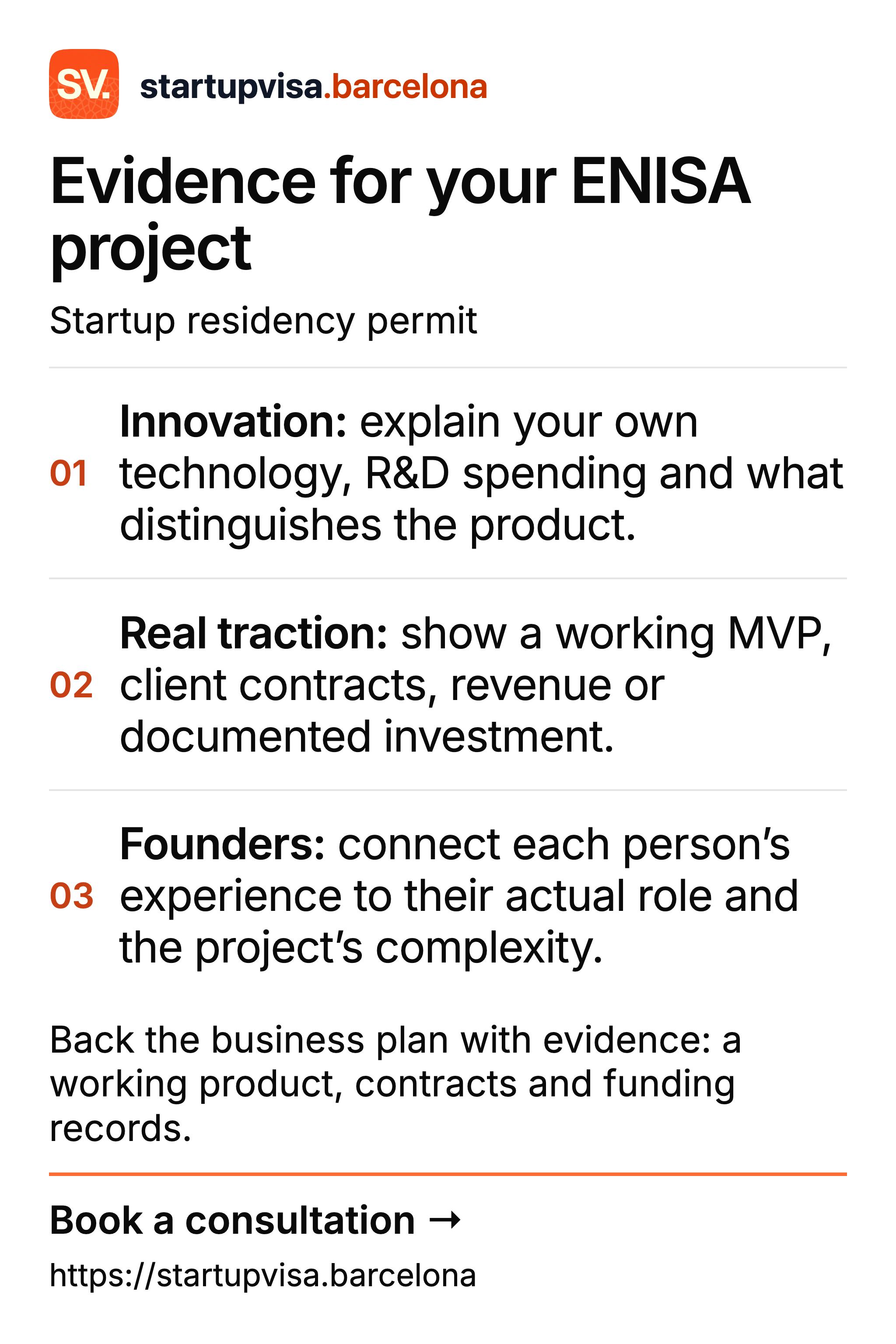
Innovation carries the most weight. Describe your own technology, your R&D spending, and what clearly sets you apart from others in the niche
Traction
Show traction: a product at MVP stage or launched, investment received, and clients — at least pre-contracts or letters of intent
The founding team
Present the founders as talent — the team must match the project's complexity and field
B2B preferred
B2B reads better than B2C. General wording will not work — explain exactly how the product works, why, and what your unique value proposition is
Approval statistics for 2026
Our data on startup visa approvals for real founders and projects
Approvals across our own cases
Our own figure for the applications we handled, not official data. It holds at this level when there is a real, operating project behind the application. It is not a guarantee for your case.
What gets applications approved
Approval chances rise when the project can show:
- A product that exists — a launched service or app that can be tested
- Real clients — contracts, or genuine payment-system statements
- Funding — documented investment or named investors
- Founders with entrepreneurial experience — previous startups, verifiable online
Which types of innovation qualify
Four kinds of innovation that pass ENISA review
Breakthrough innovation
A new technical or scientific solution
A new neural network, or a new material with unique properties — needs published research and patents
Improvement innovation
A better version of an existing solution
A retrained neural network that outperforms competitors, or implants that last 25 years instead of 10
Combinatorial innovation
Existing solutions combined into something new
Connecting two neural networks to get a new business result
Diffusion innovation
A solution moved from one field to another
Using GPT to generate management reports from video instead of text
Requirements
An innovative business plan — most serious IT projects can qualify
Professional experience that matches your business plan
A legal way to enter Spain (any Schengen visa, of any duration)
A startup idea — project description, business model, and some traction
Proof of funds: 200% of the annual SMI — €34,188 in 2026, plus more for each family member
Procedure and timeline
Every step, from preparing your documents to collecting your residence card.
Write your business plan
Write your business plan in the ENISA form format and prepare your documents
1 weekCome to Spain
Enter Spain and scan your passport, including the entry stamp. Everyone who applies must be in Spain legally
Upon arrivalSubmit documents online
Upload your documents as PDF files and submit the residence permit application online
1 dayWait for the decision
About 8 weeks in practice: roughly 5 weeks for the ENISA report and 3 weeks for the UGE decision. The legal deadline is 20 working days (art. 76.1), but it pauses while the report is awaited. You do not have to wait in Spain.
~8 weeksGet the approval
The decision arrives as a PDF file. You do not need to collect anything in person at this stage
When readyGive your fingerprints
In person in Spain only: book a police appointment, go, and give your fingerprints
1 visitCollect your residence card
Collect your residence card (TIE, a plastic card). Everyone who gave fingerprints collects their card in person
3-5 weeksDocuments you need
What the main applicant and each family member file
Main applicant
- Passport scan — all pages
- Bank statement showing €34,188 (2026)
- Health insurance
- Fee payment receipt — €73.26
- Main application — Form MI-T
- Criminal record certificate with sworn (jurada) translation, plus a criminal record declaration
- Business plan, in the ENISA form
- Proof of legal entry into Spain
- Power of attorney, if someone files for you
Family members
- Main application — Form MI-F
- Fee payment receipt
- Marriage or birth certificate with sworn (jurada) translation
- Passport scan — all pages
- Health insurance
- Bank statement (same as the main applicant)
- Criminal record certificate with sworn (jurada) translation
- Proof of legal entry into Spain
- Power of attorney, if someone files for you
- Certificate that the marriage is still valid
Legal framework
The official documents and laws that govern the startup visa
Residencia para emprendedores
Ley 14/2013
Official UGE Instructions
Filing instructions from the Unidad de Grandes Empresas (UGE)
Download the PDF instructions“La solicitud de autorizaciones de residencia previstas en esta sección prorrogará la vigencia de la situación de residencia o de estancia de la que fuera titular el solicitante hasta la resolución del procedimiento”
— Article 76, Ley 14/2013, On extending legal stay while the application is reviewed
Frequently asked questions
Answers to the most common questions about the startup visa
The government fee is €73.26. You also pay for health insurance, an apostilled criminal record certificate, and sworn translations. The total rarely exceeds €300–600. At roughly 8 weeks end to end, it is a low-cost route for entrepreneurs to test.
Several founders can apply together. Three co-founders (CEO, CTO, CMO) is a typical setup that works well. Up to 5 can apply for complex tech projects with substantial R&D, or when every founder has proven entrepreneurial experience. Each founder gets an individual residence permit with full work rights in Spain.
Will be checked only when renewing residence permit. You must at least open a company and start some activity. If you do nothing — no sanctions, but you won't be able to renew residence permit.
ENISA assesses the technological core of a project, not the industry it sits in: what you built yourself, where the technical risk lies, and whether the solution can grow without costs rising in step. Present that part of your project — your own development, your data, your product — rather than a general business description. If there is no technological core, repackaging will not create one: ENISA asks for evidence, and what works best is a running project with a product, customers, and a team. If that is not your situation, it is worth looking at another route, such as the digital nomad residence permit.
Yes! Spain startup visa includes family reunification benefits. Eligible family members: spouse/partner, children under 18, financially dependent adult children over 18, and parents (with proof of dependency). All family members receive full Spanish residence permits with complete work authorization — both employment and self-employment rights. Family members may also apply for Beckham Law if they meet eligibility criteria.
Across the applications we have handled ourselves, the approval share runs at about 87% when there is a real, operating project behind the file. That is our own figure, not official data, and it is not a guarantee for your case. Timing: about 8 weeks end to end — roughly 5 weeks for the mandatory ENISA report and 3 weeks for the UGE decision. By law the deadline is 20 working days (art. 76.1 Law 14/2013), but it is suspended while that report is awaited (art. 22.1.d Law 39/2015), which is normal procedure rather than a delay. What actually moves the outcome: a working product or MVP, real customers or contracts, documented funding, proven team experience, and a clear innovation case.
Startup visa founders can access Spain's Beckham Law — 24% flat tax for 6 years. Note: to qualify, founders typically structure through an SL company (Spanish limited company), receiving income as salary or administrator compensation. Corporate tax: 15% for first 4 profitable years (vs standard 25%), plus R&D deductions up to 42%. Without Beckham, personal income uses progressive rates (up to 47%). Tax structuring is complex — consult a Spanish tax advisor for your setup.
Spain startup visa offers superior benefits for serious entrepreneurs: 3-year initial permit, path to permanent residency and citizenship, no minimum income requirement, family reunification rights, and freedom to build a local business and hire employees. The digital nomad visa (also up to 3 years when filed from Spain via the UGE) requires proof of about €2,849/month in income, is for remote work only, and limits local business activities. For tech entrepreneurs building companies, the startup visa provides much better long-term opportunities in Spain and the EU.
No worries! Spanish immigration law (Article 76, Ley 14/2013) automatically extends your legal stay during startup visa processing. You can remain in Spain legally throughout the review period, even with an expired Schengen visa. Restriction: no EU travel until residence permit approval. This legal protection ensures entrepreneurs don't face overstay issues while their startup visa application is processed.
Spain startup visa has no nationality restrictions. Russian, Ukrainian, Belarusian, and other CIS citizens regularly receive approvals. In recent years, over 50% of approved applications have come from Russian and CIS passport holders. Spain evaluates projects on merit, not nationality. Focus on strong business plan, innovation, and genuine entrepreneurial activity — nationality is not a barrier.
Strongly not recommended. This means lack of focus and uncertainty in projects. Founder should be fully dedicated to one specific business. However, you can have existing business as gained experience.
Spain startup visa approval requires strategic preparation: 1) Build working MVP before applying, 2) Secure real customers/contracts with documented revenue, 3) Show funding sources (personal, investors, grants), 4) Demonstrate team's tech expertise and previous experience, 5) Create detailed 3-year business plan with market analysis, 6) Highlight clear innovation and scalability, 7) Prepare all documents professionally. Thorough preparation is the single biggest factor in the outcome.
UGE may send a requerimiento for subsanación — for example, asking you to clarify the business plan or financial documents. Under Ley 39/2015 (art. 68), you have 10 business days from the notification date to respond (extendable by up to 5 more days on reasonable request). If you don't respond in time, the application is considered withdrawn (desistido). We handle the requerimiento response for you, start to finish.
Yes, but there's an important nuance for the startup visa. Formally, a refusal (resolución denegatoria) can be appealed — you file a recurso, usually within 1 month. But if the refusal is based on a negative assessment of the business plan, appealing is generally not worth it. It's far more effective — and this is both allowed and works well — to reapply for the residence permit, revising and updating the ENISA business plan based on the feedback. We review the reason for refusal and choose the right tactic: appeal or resubmission with a strengthened project.
After approval — once you're in Spain — you'll need to submit fingerprints (huellas) and get your TIE card, register your address (padrón) at the town hall, and set up a certificado digital / Cl@ve. The key step for the founder: register a company (usually an SL) within 6 months — no later — and register as an autónomo societario. It's exactly this ongoing activity that gets checked at renewal. We'll guide you through the right sequence and recommend trusted services, including SL incorporation and tax structure.
Yes. This is lawful residence in Spain, so the years count towards both milestones: five years of continuous lawful residence for permanent residence (residencia de larga duración) and ten years for citizenship by residence, which is the general term applying to most nationalities under article 22 of the Civil Code. Switching permit type does not reset the clock — years spent on the Digital Nomad permit, the startup/entrepreneur permit and the highly qualified professional permit add together, including when you move from one to another. What matters is that lawful residence is not interrupted and that renewals are filed on time. Shorter citizenship terms exist for some nationalities: two years for citizens of Ibero-American countries, Andorra, the Philippines, Equatorial Guinea and Portugal, and for Sephardic Jews of Spanish origin; one year in cases such as marriage to a Spanish citizen or being born in Spain.
Still waiting after 20 working days?
Check whether positive administrative silence may apply, then build the request PDF in your browser — nothing is sent to us.
Your Expert
Denis Moskalets
Founder & Immigration Expert
Denis has helped 1,500+ professionals relocate to Spain since 2022. Ex-startup founder and CTO with 18+ years in software engineering. He moved to Spain himself and knows the process first-hand.
- ✓1,500+ successful cases
- ✓98% approval rate
- ✓Personal relocation experience
Startup visa guides by situation
Pick the guide that matches where you are filing from or what you are building.
Related guides
Core pages for choosing the right Spanish residence route.