


📅 Updated 20 October 2026
Law 14/2013 · UGERenewing your Digital Nomad residency permit in Spain
A renewal gives you two more years. UGE asks for five documents, and the one that decides the file is your last two Spanish tax returns — each judged against that year's income threshold. You can file from 60 days before your card expires.
Renewal with us: €600 for the main applicant
Start renewal orderNo payment now: we review your answers first and send a payment link once we agree the service.
Renewal in four facts
The figures below are what UGE checks; the sections that follow explain each one.
- Renewal term
- 2 years art. 74 quinquies.3, Law 14/2013
- Documents
- 5 for the main applicant
- Income test
- ≥ 200% SMI in each tax year, before deductions
- Filing window
- 60 days before 90 days after expiry
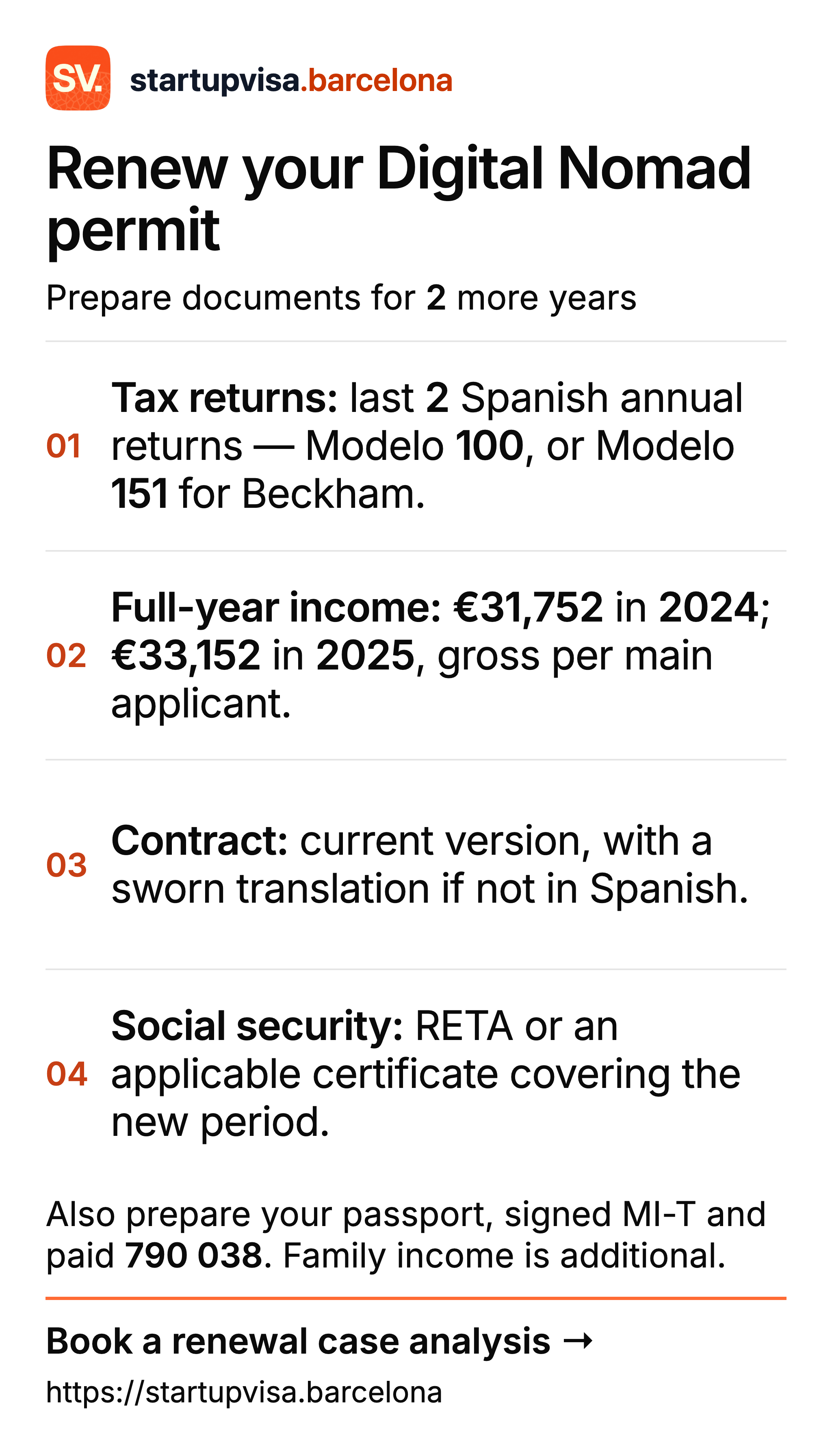
What documents UGE asks for at renewal
The renewal set is shorter than the first application. As observed on UGE's online form in June 2026 and in our own renewals.
Main applicant — 5 documents
Tasa 790 038
The fee form together with proof of payment.
Passport
The data page is what is asked for; we recommend uploading a full scan.
MI-T application form
Signed. Sign electronically if you can — it avoids a scan of a wet signature being questioned.
Active contract with the foreign company
With a sworn (jurada) translation, as at the first application. It has to still be in force and should cover the two-year renewal period.
Spanish tax returns for the two tax periods before the renewal year
The full returns filed with Agencia Tributaria: Modelo 100 (Renta), or Modelo 151 if you are on the Beckham regime. This is the item UGE reads first.
Spouse and children — 4 documents each
MI-F application form
Signed for each family member.
Tasa
A separate paid fee for every applicant.
Proof of the family link
A declaration that the marriage is still valid, plus the marriage certificate or the child's birth certificate.
Passport
Full scan, all pages.
No longer requested (as of June 2026)
- Company registry extract or certificate of good standing
- Employer or client letter
- CV
- Diplomas and proof of professional experience
- Bank statements and invoices
If your employer or your contract changed since the first application, expect the company documents to be asked for again.
The two tax returns
Renewal is a tax-residence test as much as an immigration one. UGE reads the income before deductions and expenses on each return and compares it with the Digital Nomad threshold for that tax year — not with this year's figure.
Modelo 100 — the ordinary Renta
The annual return most residents file. Self-employed (autónomo) nomads always have one; employed nomads have one if they were tax resident in Spain that year.
Modelo 151 — the Beckham regime
If you opted into the special regime for inbound workers, your annual return is Modelo 151 instead of Modelo 100. The income test is the same. See our Beckham Law guide for how the regime works. Whether you can still opt into it is a separate question — run the eligibility check.
Modelo 210 — non-residents
In theory a nomad who was not tax resident files Modelo 210. As of September 2026 we have not seen a renewal decided on a 210 alone, so treat this as untested and talk to us before relying on it.
The threshold is 200% of that year's SMI for the main applicant, plus 75% for the first family member and 25% for each further one. Each year has its own decree:
Renewal income threshold by tax year (main applicant)
| Tax year | SMI (14 pays) | Per month | Per year | Source |
|---|---|---|---|---|
| 2024Real Decreto 145/2024 | €1,134 | €2,646 | €31,752 | Real Decreto 145/2024 |
| 2025Real Decreto 87/2025 | €1,184 | €2,762.67 | €33,152 | Real Decreto 87/2025 |
| 2026Real Decreto 126/2026 | €1,221 | €2,849 | €34,188 | Real Decreto 126/2026 |
The Renta for the last tax year cannot exist before its filing campaign opens in April. If you file the renewal before that, UGE sees the two earlier returns — say so in a short cover note rather than leaving the gap unexplained.
Check a tax year against its threshold
Pick the year of the return, add your family, and enter the income before deductions shown on it.
Optional. Leave empty to see the threshold only.
Everything is calculated in your browser. Nothing you type is uploaded or stored.
General information, not legal advice. UGE compares each year against its own threshold and also looks at the contract, social-security cover and the rest of the file.
Open the full income calculatorSelf-employed (autónomo) nomads: the RETA registration date matters
If your permit runs on the self-employed path, UGE checks the gap between the date your first authorisation was granted and the date you registered as autónomo with Spanish Social Security (RETA). In our practice a gap of more than about two months draws questions at renewal.
If the gap between the date your permit was approved and your RETA alta date is more than 2–2.5 months, you risk a requerimiento which, as of September 2026, cannot be satisfied.
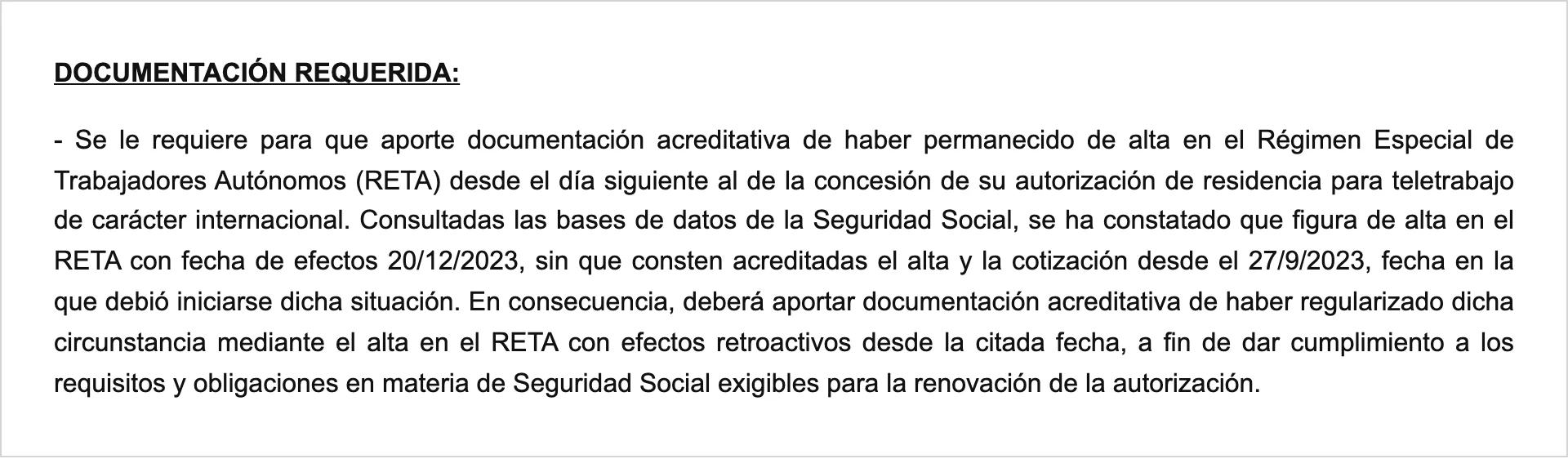
Translation of the requerimiento
REQUIRED DOCUMENTATION: — You are required to provide documentation showing that you have remained registered with the Special Scheme for Self-Employed Workers (RETA) from the day after your residence authorisation for international teleworking was granted. Having consulted the Social Security databases, it has been established that you appear registered in RETA with effect from 20/12/2023, and that registration and contributions from 27/9/2023 — the date on which that situation should have begun — are not evidenced. Consequently, you must provide documentation showing that you have regularised that circumstance by registering with RETA with retroactive effect from the said date, in order to comply with the Social Security requirements and obligations that apply to the renewal of the authorisation.
In the requerimiento UGE asks you to show a RETA alta from the day after approval. A retroactive alta as such is allowed — but moving the date of an existing alta back is currently impossible: Seguridad Social puts such requests on hold pending verification.
If your registration was late, do not file a plain renewal as it stands. In many cases the better move is a modification of your authorisation to trabajador por cuenta propia rather than a renewal — talk to us before you file so we can look at your dates. If you registered on time, the renewal is straightforward: keep RETA active and keep the contract alive.
Renewal with us
We prepare and file your renewal
Start with 3 short screens of questions. We look at your situation and agree the work with you before you pay.
€600
for the main applicant
Family members renewing with you: we agree their price before payment.
No payment now. We review your answers and send a payment link once we agree the service.
What's included
- Review of your documents and tax returns
- MI-T and MI-F forms and the cover notes
- Filing the renewal with UGE
- Watching for UGE notifications
- Answering a requerimiento on this filing
Agreed separately
Fixing debts or past problems, employer registration with Spanish Social Security, a modification instead of a renewal, appeals, translations, government fees and tax filing.
UGE makes the decision. Your answers help us choose the right service; we check the documents themselves when we prepare your file.
What the questionnaire asks
The questionnaire is a request for us to assess your renewal. It is not an application to UGE, a payment or an approval: we read your answers, agree the service with you, and only then send a payment link.
Every question needs an answer unless it says it is optional. “I'm not sure” and “I don't remember the date” are valid answers.
Who is renewing
Family members renewing with you: 0 to 10 adults and 0 to 10 children. The income question shows your family's annual threshold for the last 2 tax years.
Your permit and work
- What do you hold now?: Digital Nomad residency permit (TIE card) · 1-year Digital Nomad visa from a consulate · Another residency permit · I'm not sure
- When does it expire?: I don't remember the date
- How do you work for your foreign company or clients?: As an employee · As a freelancer or contractor
- Country of your employer (only if you work as an employee)
- Who covers your social security? (only if you work as an employee): A certificate from my home country (A1, Certificate of Coverage, SFR certificate or similar) · Spanish Social Security, paid by my employer · Neither of these · I'm not sure
- RETA registration date in Spain (optional) (only if you work as a freelancer or contractor): I don't remember the date
Taxes and income
- Have you filed your last 2 Spanish annual tax returns?: Yes, for both years · No, at least one is missing · I'm not sure
- In those 2 years, was your income at or above the threshold for your family?: Yes, in both years · No, in at least one year · I'm not sure
Your contacts
- Name
- Telegram (optional)
Before sending
You tick 2 boxes yourself: that your answers are true, and that you agree to the personal data terms and the request terms. An assistant can't tick them for you.
personal data processing termsterms for assessing my renewal request
You see every answer before it is sent and can change it. Sending is free; we reply by email or on Telegram.
Where to check your filing dates
The window opens 60 calendar days before your TIE expires and a renewal filed up to 90 calendar days after expiry is still accepted, although late filing can open a penalty file. If you hold the national D visa rather than a TIE, your next step is a first residence application and there is no grace period. Enter your expiry date to see your dates.
Check your own filing window
Enter your expiry date to see which rules apply to you.
Which document do you currently hold?
Everything is calculated in your browser. Your date is never uploaded or stored.
General information, not legal advice. Check both the date and the document type — a visa expiry and a TIE expiry are not the same thing.
Your filing window
- Window opens
- Document expires
- Late filing limit
Questions about renewal
Contracts, tax forms, a low year, the D visa and the autónomo clock.
No, if the contract from your first application is still in force. Submit it with its sworn translation. If it was replaced or re-signed, submit the current version — and check it covers the next two years before you pay for a new translation.
The full annual return for each of the two tax periods before the renewal year: Modelo 100 for the ordinary regime, Modelo 151 on the Beckham regime. The figure UGE reads is income before deductions and expenses.
Not in our experience, but the gap has to be explained and evidenced rather than left for UGE to find. How that is done — a supporting letter, savings, employer confirmation — is set out in our July 2026 renewal update.
They are no longer on UGE's renewal list as of June 2026. Keep them anyway: if a year's income is short, they become part of the explanation.
No — it is a first residence application with its own window. The deadline calculator explains the difference and shows your dates.
Talk to us before filing. In the requerimiento UGE asks for a RETA alta from the day after approval. A retroactive alta as such is allowed, but moving the date of an existing alta back is currently impossible: Seguridad Social puts such requests on hold pending verification. That is why a modification to cuenta propia is often the better route than a plain renewal.
Either switch to the self-employed path (RETA plus a modification to cuenta propia) or have your employer register with Spanish Social Security and pay contributions here. Start before your renewal window opens; both take weeks.
20 working days, and silence counts in your favour — see the deadline page for the detail and the positive-silence generator once the deadline has passed.
Where these rules are written
The two provisions behind the two-year term and the renewal conditions. The filing window has its own page.
The first residence authorisation lasts up to three years; renewals are for two-year periods while the conditions that generated the right are maintained.
Spanish original
«La validez de esta autorización tendrá una vigencia máxima de tres años salvo que se solicite por un período de trabajo inferior. Los titulares de esta autorización podrán solicitar su renovación por períodos de dos años siempre y cuando se mantengan las condiciones que generaron el derecho.»
This authorisation is valid for a maximum of three years unless requested for a shorter period of work. Its holders may apply for renewal for two-year periods provided the conditions that generated the right are maintained.
Renewals are filed electronically, and the Directorate-General for Migration may request whatever reports it needs to decide whether the conditions are still met — which is why the tax returns and the social-security position are read so closely.
Spanish original
«Los titulares de una autorización regulada en esta sección podrán solicitar su renovación por periodos de dos años siempre y cuando mantengan las condiciones que generaron el derecho, sin perjuicio de lo establecido en el artículo 67.2. Las renovaciones se tramitarán utilizando medios electrónicos. La Dirección General de Migraciones podrá recabar los informes necesarios para pronunciarse sobre el mantenimiento de las condiciones que generaron el derecho.»
Holders of an authorisation regulated in this section may apply for its renewal for two-year periods provided they maintain the conditions that generated the right, without prejudice to article 67.2. Renewals are processed electronically. The Directorate-General for Migration may obtain the reports it needs to rule on whether the conditions that generated the right are maintained.
Ready to renew with us?
We prepare and file Digital Nomad renewals. Start with the short questionnaire, and we agree the work before you pay. For a file with something awkward in it — a late RETA alta, an A1 that expires mid-permit, a year that came in under the threshold — there is also an in-depth paid case analysis.
Employees: your social-security certificate must still cover you
At renewal UGE looks again at who pays your social contributions. For an employee that is the certificate of applicable legislation from your home system — an A1 in the EU, EEA and UK, a Certificate of Coverage from the US, the SFR departure certificate from Russia — and it has to cover the new two-year period.
HMRC issues the certificate for a posting of up to two years — you apply on form CA3822 and your employer confirms on CA3821. Beyond 24 months, HMRC and the Spanish authority agree an extension only in exceptional circumstances (GOV.UK guidance). We do not recommend planning a renewal around it: treat it as a document that will run out before your second card does, and prepare the switch below before your renewal window opens.
An A1 rests on the posting rule in Regulation (EC) 883/2004, article 12: the posting is not expected to exceed 24 months. Some institutions issue for shorter periods and renew. Check the end date against your renewal, not against today.
We support both routes. The choice depends on your contract, your tax position and how your employer feels about Spanish payroll.
A Certificate of Coverage under the US–Spain Totalization Agreement can run up to five years for a detached worker (SSA: Totalization Agreement with Spain). Check that its end date covers the renewal period, and that the wording still says you work remotely from Spain.
Related reading