


Silencio Positivo under Spain's Law 14/2013: How It Works and How to Request It
What to do when UGE misses the 20-working-day deadline under Law 14/2013: counting the period, when it is suspended, how to request a resolution or certificate, and a free in-browser PDF generator.

What is silencio positivo for a Law 14/2013 residence application?
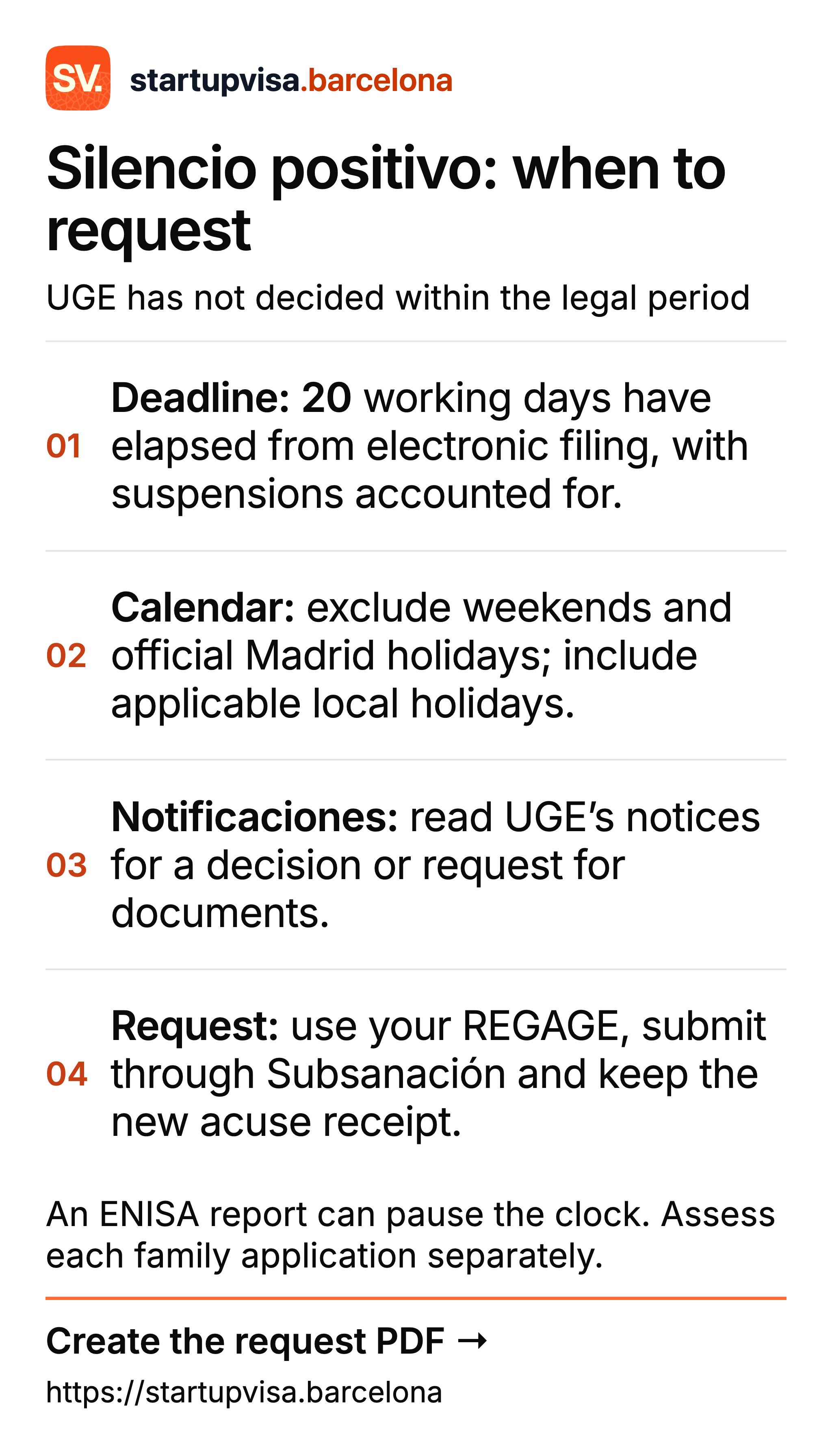
In plain terms. You filed for residence. The authority has 20 working days to answer. It did not answer — and by law that counts as a yes: the authorization is granted, even though nothing has reached you on paper yet. That is silencio administrativo positivo, positive administrative silence. What is left is getting a document that says so.
Three things to be clear about up front:
- This is not a special visa and not a favour you can obtain by sending a reminder — it is the consequence of a deadline the authority missed.
- The period is counted in working days, and it can be formally suspended. If it was, the 20 days have not run out yet even if more than a month has passed on the calendar.
- The silence already produces the legal effect, but in practice you need the document: a resolution or a certificate you can actually use.
Now the legal detail. Article 76.1 of Spain's Law 14/2013 gives the competent authority a maximum of 20 days to decide residence authorizations covered by that section. If no decision is made in time, the authorization is understood to be granted by positive administrative silence. The practical problem is proving that the conditions were met and obtaining an express resolution or certificate that other authorities can use.
If you already know your dates and want the document, use our free silencio positivo PDF generator. It builds the Spanish request in your browser without sending names, passport numbers, or NIEs to our server.
Which UGE applications can use the 20-day positive-silence rule?
The rule concerns residence authorizations in the relevant international-mobility section of Law 14/2013. The official UGE portal lists entrepreneurs, highly qualified professionals and EU Blue Card holders, researchers, intra-company transferees, international teleworkers, audiovisual-sector workers, and their family members.
It can apply to an initial application or a renewal, and to the main applicant (titular) or a family member, when that person's own filing meets the conditions. It does not automatically transfer from the titular to the family: each applicant normally has an individual electronic registration number and must be checked separately.
When do the 20 days start, and are they working days?
Start with the electronic filing date shown on the acuse. Article 76.1 ties the period to electronic filing with the body competent to process the application. Under Article 30.2 of Law 39/2015, a period stated in days is counted in working days unless the law expressly says calendar days. Saturdays, Sundays, and declared public holidays are excluded.
Do not simply add 20 calendar days. First check whether UGE issued a requerimiento — a formal notice asking you to correct the file or supply documents. Article 22.1.a of Law 39/2015 allows the running of the maximum decision period to be suspended between notification of that requerimiento and compliance or expiry of the response period.
What a requerimiento is and how to answer it is on its own page; which permits the UGE decides and how long a decision takes in practice is on the UGE page.
Entrepreneur (startup) files deserve a separate warning. There is almost always a second pause that applicants do not know about. Under Article 70.1 of Law 14/2013, UGE must ask ENISA on its own initiative for a report on the business project, and that report is mandatory (preceptivo). Article 22.1.d of Law 39/2015 then allows the 20-day period to be suspended while the report is awaited — from the date of the request to the date it arrives, up to three months. So on startup applications the real wait routinely runs well past 20 working days, and that is the procedure working normally rather than an overdue file. Positive silence can only be argued once the ENISA report has come back and the suspension has ended. Note that the suspension has to be notified to you; if it never was, that is a point in your favour.
Count on Madrid's calendar. UGE sits in Madrid, so it is not only the Spanish national holidays that count but Madrid's own regional and city days: 2 May (Comunidad de Madrid), 15 May (San Isidro) and 9 November (Nuestra Señora de la Almudena). Those are the easiest ones to miss, and each of them pushes the deadline out by another day. And under article 30.6 of Law 39/2015 a day counts as non-working if it is non-working either at the seat of the authority — Madrid — or in your own municipality, so check your local calendar too.
What to check: the electronic filing date; public holidays — not only national and Madrid ones but also those where you live, since under Article 30.6 of Law 39/2015 a day that is non-working either in your own municipality or at the seat of the authority counts as non-working; every notification; the date you opened the electronic notification containing the requerimiento and the date you answered it; and, on startup files, the ENISA waiting period. If any element is uncertain, verify the calculation before relying on silence.
How do I file a request for a silencio positivo resolution?
The Ministry now gives a direct official instruction: when the legal period under Law 14/2013 has passed without notification of a residence decision, the interested person may request a resolution granting the authorization by silence. The request must be filed through the Ministry's electronic office using Alta de Solicitud → identification with DNIe or electronic certificate → Subsanación.
- Download the original filing receipt (acuse) and check the applicant's REGAGE and date.
- Create one Spanish request for that pending applicant with the browser-only PDF generator.
- Review the facts, sign if appropriate, and upload the PDF through the official route.
- Download and retain the new submission receipt.
- Continue checking the expediente and electronic notifications.
The generator prepares the document only. It does not log in, sign, submit, or contact UGE for you.
Will filing a silencio positivo request help my case?
It can help turn a legal effect into an official document, but it does not create the positive silence. If the conditions were already met, the request gives UGE a clear, registered demand to recognize it and provides a new receipt showing when the certificate or resolution was requested.
Article 24.4 of Law 39/2015 says an act produced by administrative silence can be proved by any evidence admitted in law, including a certificate. That certificate must in fact be issued on the administration's own initiative within 15 days of the deadline expiring, without any request from you. The interested person may also request it at any time; the provision then gives the competent authority 15 days, counted from the day after the request enters its electronic registry.
Filing too early, ignoring a suspension, using the wrong applicant's REGAGE, or filing after an express decision will not repair the underlying problem. That is why the generator requires you to confirm the deadline conditions before it downloads the PDF.
Does positive administrative silence mean the residence permit is legally granted?
Once the 20 working days are up, positive silence happens on its own. There is nothing to activate: the authorization is deemed granted at the moment the deadline expires, not at the moment you ask about it. The request described above simply puts on record a fact that has already occurred, and gets you a document you can use.
That has a practical consequence worth knowing. After the deadline has passed, the administration can no longer reverse the outcome. Under article 24.3 a later express decision may only confirm the positive act, not undo it, and a requerimiento issued after that point does not retroactively suspend the period — the authority has no right to demand further documents from you in order to get around the silence. So if the file was complete, the application was signed, and your criminal-record certificate is clean, a favourable outcome is very likely — that is what the law says.
It is still not an automatic guarantee: the point can be disputed if the dates do not line up, if a suspension was notified in time and you missed it, or if there is a substantive ground for refusal on the file. Check the dates before you file.
Article 24.2 of Law 39/2015 states that an approval produced by positive silence is an administrative act that ends the procedure. Article 24.3 adds that a later express decision in a positive-silence case may only confirm that act.
In real life, however, the applicant often still needs usable administrative proof: a favorable resolution or certificate, correct records, and then the next step appropriate to the authorization, such as arranging the TIE when required. Do not confuse the legal effect with having a plastic residence card or with every database already being updated.
Should the titular and family members submit one combined request?
Normally, no. Each person has an individual application and registration number, so each pending person should be evaluated and documented independently. A titular may already have a favorable resolution while a spouse's or child's application is still pending.
For a family-member letter, identify the family applicant's own REGAGE and refer to the titular through whom the right derives. Do not submit a silence request for a person who already received a favorable or unfavorable resolution. The family option in the generator asks for both sets of references and creates a separate letter.
What information should a silencio positivo request contain?
A practical request identifies the applicant and filing, states the legal basis, and asks for a resolution certifying the positive result. Our template uses:
- the applicant's full passport name, passport number, optional NIE, date of birth, and nationality;
- the applicant's electronic registration number and filing date;
- initial or renewal, residence category, and titular or family role;
- for a family member, the relationship and titular's identifying filing details;
- Article 76.1 of Law 14/2013 and the 20-working-day fact;
- a direct SOLICITA asking for the certifying resolution.
Use the exact Latin spelling shown in the passport and check every number against the acuse before uploading the generated PDF.
What happens after I submit the request?
Keep the new receipt and monitor both the case status and electronic notifications. UGE may issue an express favorable resolution or a certificate, or the expediente may require case-specific follow-up. Article 24 does not remove the administration's duty to issue an express decision.
If you receive a new notification, read it before sending anything else. If the case involves a disputed suspension, an earlier decision, a representative change, or inconsistent application dates, get individual legal advice. A template is valuable when the facts are clean; it cannot decide contested facts for you.
Ready to prepare the request? Generate the PDF privately on your device.
Frequently asked questions about silencio positivo
Direct answers to the questions applicants most often ask after the UGE deadline passes.
Is silencio positivo automatic after 20 working days?
The legal effect can arise on its own once the statutory conditions are met. But you still have to establish the dates, that the application was filed with the competent body, that no express decision was issued, and that no suspension applied. Requesting a certificate or resolution creates convenient proof, but it does not replace checking those facts.
Why is my startup file still pending after 20 working days?
Because the period is most likely suspended. On entrepreneur files UGE must obtain a mandatory report from ENISA (Article 70.1 of Law 14/2013), and the period is suspended while that report is awaited (Article 22.1.d of Law 39/2015). The real wait on startup cases therefore almost always runs past 20 working days. You can only rely on silence once the report has arrived and the suspension has ended.
Can I request silencio positivo for a renewal?
Article 76 regulates the procedure for the residence authorizations in the section and expressly addresses electronic renewals. Check the specific renewal filing, its own date, notifications, and any suspension before relying on the 20-day rule. See our Digital Nomad renewal guide for the documents and timing around the underlying renewal.
Is the PDF generator free, and where does my data go?
The generator is free. The form and the PDF run in your browser: the name, passport number, NIE, and registration numbers you type are not sent to our server — the document is built on your device.
Important legal note
This guide and generator provide general information and a document template, not case-specific legal advice. A wrong date, a formally suspended period, an already-notified decision, or a procedure outside the applicable section of Law 14/2013 can change the conclusion. When the facts are disputed or unclear, have the expediente reviewed before filing.
The generator writes the letter itself and stays free; when the harder question is whether your period was suspended by a requerimiento or a pending ENISA report, and what to do with whatever UGE sends back, that is the case work we take on, through to the resolution.
Calculate your 2026 Digital Nomad income threshold
Use the SMI-based calculator before collecting bank statements, salary letters, and family documents.
Open income calculatorEstimate whether Beckham Law is worth it
Compare the 24% special regime with a rough regular IRPF estimate and see where the saving becomes material.
Open Beckham calculator