


📅
🧾 Digital Nomad residency permit · self-employedWhat proves you are self-employed?
For a Digital Nomad residency permit, UGE wants a client contract of at least 3 months, a client company trading for at least 1 year, and 3 months of invoices matched to your bank. Below: what your country issues, what gets an apostille, and why you register with RETA.
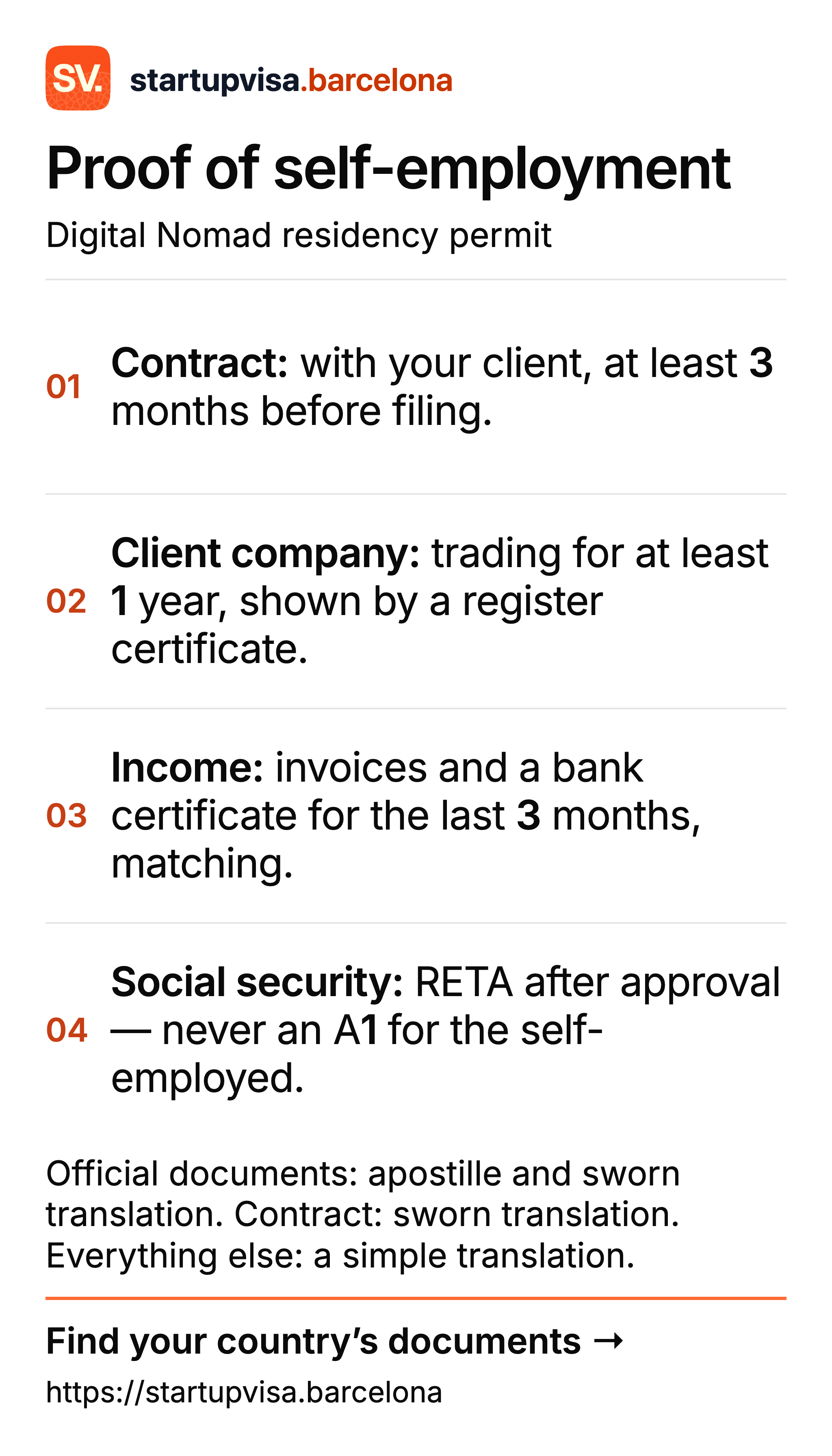
The 4 things UGE checks for a self-employed applicant
- Contract with your client
- At least 3 months
- Client company trading
- At least 1 year
- Invoices and bank certificate
- The last 3 months
- Social security
- RETA, after approval
What UGE asks a self-employed applicant for
UGE’s documentation sheet for the main applicant has no line for a “certificate of self-employment”. It asks for evidence of the work itself. Each item below links to the page that shows how to prepare it.
A contract with your client, at least 3 months old
A commercial contract with the company outside Spain you work for, in force for at least 3 months before you file. UGE’s FAQ says a freelancer qualifies on exactly this basis. The sheet adds that evidence of an employment relationship does not prove a professional one, and the other way round, so the contract has to match the relationship you declare. What the contract should say is in the Digital Nomad guide, documents section.
Your client company, trading for at least 1 year
An official commercial-register certificate, or its equivalent in the company’s country, showing at least 1 year of real and continuous activity. This requirement is about your client, not about you. That is why a country with no register of freelancers is less of a problem than it looks.
Invoices and a bank certificate for the last 3 months
Your invoices for the 3 months before filing, and a bank certificate in your name, stamped and signed by the bank, for the same 3 months, with the payments for those invoices marked separately. Both are private documents: they are not apostilled. How banks certify statements is in bank statements for a Spanish application.
If you invoice through your own company
If you are the sole owner or control the company, 100% ownership and more than 1 year of the company’s activity stand in for the 3-month contract. UGE then asks for more: proof of ownership or control, the company’s last corporate tax return, evidence of investment in productive assets, and a home social security report on the company’s employees.
A certificate of your own status, where your country issues one
The sheet does not list it, but a register extract or tax registration that names you as self-employed backs up the contract. Our Digital Nomad guide includes it in the document set. The country matrix below shows what each country actually issues, and our post on self-employment certificates covers the US documents in detail.
Which documents get an apostille, and which translation
An official document issued by a foreign authority, such as a register extract, is apostilled or legalised, unless an EU rule or a bilateral agreement exempts it, and then gets a sworn translation (by a traductor-intérprete jurado authorised by Spain’s foreign ministry) together with its apostille. Your contract with the client also gets a sworn translation. Invoices, bank certificates and letters are private documents: no apostille, and a simple translation is enough.
By country: what exists and what it says
One card per country, sourced to the authority that issues each document. Each card says what the document is, who issues it and what it states. It does not say whether UGE will accept it: UGE publishes no country-by-country criteria.
3 of 3 countries shown
United States
Schedule C (Form 1040)
The business profit-and-loss schedule you file with your federal tax return. Its companion, Schedule SE, calculates the self-employment tax.
- Issued by
- Filed by you with the Internal Revenue Service (IRS)
- What it says
- The form’s own title reads “Profit or Loss From Business (Sole Proprietorship)”. A copy you print yourself has no IRS signature or seal, so there is nothing on it for an apostille to certify.
Private documentStates self-employmentIRS — About Schedule C (Form 1040)Tax Return Transcript
An IRS record of the return you filed, ordered through the IRS transcript service.
- Issued by
- Internal Revenue Service (IRS)
- What it says
- It repeats most lines of the return you filed, with its schedules. It does not certify a status. The State Department apostilles a federal document only with the agency’s original signature and seal on it, so ask for a signed copy before you plan an apostille.
Public documentSays nothing about statusApostilleIRS — Transcript typesCP575 / Letter 147C
The IRS notice confirming an Employer Identification Number (EIN), and the replacement letter issued when the original is lost.
- Issued by
- Internal Revenue Service (IRS)
- What it says
- It confirms the EIN and nothing more. Companies, partnerships and trusts hold EINs too, and a freelancer with no staff may not have one at all.
Public documentSays nothing about statusApostilleIRS — Employer Identification Number
A federal document needs the agency’s original signature and seal. A US notary cannot issue an apostille.
TranslationSworn for the contract and public documents; simple for private ones
United Kingdom
A UK sole trader can start trading without registering first, but must register for Self Assessment once trading income passes £1,000 in a tax year. So an HMRC registration letter can exist even if no register lists you.
SA302 tax calculation (and tax year overview)
The Self Assessment tax calculation for a tax year, downloaded from your HMRC online account.
- Issued by
- HM Revenue & Customs (HMRC), through your own online account
- What it says
- gov.uk calls it evidence of your earnings and warns that a copy you print yourself is not accepted everywhere. It shows income, not status.
Private documentSays nothing about statusgov.uk — Get evidence of your earnings (SA302)Companies House certificate with certified facts
An official certificate or certified copy from the UK company register. Relevant if you invoice through your own limited company.
- Issued by
- Companies House
- What it says
- It confirms that the company exists, its number and its date of formation. That is a fact about the company, not about your status.
Public documentSays nothing about statusApostillegov.uk — Certified copies from Companies House
ApostilleFCDO Legalisation Office
The FCDO apostilles directly a document signed by a government official, such as an HMRC letter confirming tax registration, and a Companies House certificate. A contract or a copy has to be certified by a UK notary or solicitor first.
TranslationSworn for the contract and public documents; simple for private ones
Germany
Freelancers in the liberal professions (freie Berufe) do not register a trade at all. They tell the Finanzamt they have started and receive a tax number in writing. So a German freelancer often has no trade-register document of any kind.
Gewerbeanmeldung / Gewerbebestätigung
The trade registration and the receipt you get back for it — what people usually mean by “Gewerbeschein”.
- Issued by
- The municipal trade office (Gewerbeamt) or public-order office (Ordnungsamt)
- What it says
- It records that you run a trade on your own account. Read it precisely: it is a receipt for your notification, not a decision by the office.
Public documentStates self-employmentApostille§ 14 Gewerbeordnung (gesetze-im-internet.de)Bescheinigung in Steuersachen
The tax certificate a Finanzamt issues on request, formerly called a Steuerliche Unbedenklichkeitsbescheinigung.
- Issued by
- Your Finanzamt
- What it says
- It states tax facts only: arrears, how you pay, whether you file on time. It certifies no employment status.
Public documentSays nothing about statusApostilleBundesportal — Bescheinigung in Steuersachen
The Federal Foreign Office says each Land organises this differently and advises asking the office that issued the document who apostilles it.
TranslationSworn for the contract and public documents; simple for private ones
Applying with Russian documents (ЕГРИП, ЕГРЮЛ, «Мой налог», the SFR certificate)? They are covered in full on the Russian version of this page.
If your country has no register of self-employed people
Nothing in the Spanish requirements breaks. The register certificate is asked for your client company; your own side is carried by the contract, 3 months of invoices and the matching bank payments. Two cards above show how common this is: a UK sole trader can start trading without registering, and a German freelancer in a liberal profession registers no trade at all. One thing to check early: if your country is not a party to the Apostille Convention (the United Arab Emirates, for example), public documents go through consular legalisation, which takes longer.
Questions self-employed applicants ask
The contract with your client outside Spain, in force for at least 3 months before filing, your invoices for those 3 months and a bank certificate showing the matching payments. The register certificate UGE asks for is about your client company, not about you. The country matrix shows what some countries issue anyway.
They prove different things. Schedule C is the one that names the status: its title reads “Profit or Loss From Business (Sole Proprietorship)”. An EIN letter (CP575 or Letter 147C) only confirms the number, and companies and trusts hold EINs too. A Schedule C you printed yourself is not a public document, so it cannot be apostilled as it is. What the IRS issues itself is the tax return transcript.
No. A self-employed applicant registers with RETA, and UGE’s FAQ says keeping home cover under a bilateral agreement is not available to the self-employed. An A1 or a US Certificate of Coverage is for employees whose employer stays abroad; for a freelancer it does not replace RETA even if it has been issued, EU and EEA freelancers included.
After the permit is granted and before you start working in Spain. The application only carries a commitment to register. Do not wait: in our cases (September 2026) a gap of more than 2–2.5 months between approval and the RETA registration draws a requerimiento at renewal. See the renewal guide.
Official documents issued by a foreign authority are apostilled or legalised, unless an EU rule or a bilateral agreement exempts them, and get a sworn translation (traducción jurada) together with the apostille. The contract with your client also gets a sworn translation. Invoices, bank certificates and letters are private documents: they are not apostilled, and a simple translation is enough.
Yes, on a professional (not employment) basis, as long as you keep the contract you applied with and Spanish clients make up no more than 20% of your work. That is UGE’s own answer in its FAQ.
Not sure your documents prove what UGE needs?
Send us your contract, invoices and whatever your tax office issues. On a free 15-minute call we tell you what is missing, before you pay for an apostille you do not need. We are a consultancy in Barcelona working on Law 14/2013 residency permits.
Legal basis and sources
- Ley 14/2013, articles 62.3 and 62.5 (general requirements and social security) and articles 74 bis to 74 quinquies (international telework).
- Ley 14/2013, seventh additional provision: the permit ends if its conditions stop being met.
- Ley General de la Seguridad Social (Real Decreto Legislativo 8/2015), article 15: registration is compulsory for work carried out from Spain.
- Hague Convention of 5 October 1961 abolishing legalisation, article 1: what counts as a public document.
- UGE — documentation for initial Digital Nomad applications (PDF)
- UGE — FAQ on international teleworkers (PDF)
- UGE — international teleworkers
- Ley 14/2013 (BOE, consolidated text)
- Real Decreto Legislativo 8/2015, article 15 (BOE)
- Hoja informativa 61 — legalisation and translation of documents
- Spanish foreign ministry — legalisation and apostille
- Spanish foreign ministry — sworn translators
- HCCH — Apostille Convention, text and status table
General information, not legal advice. We are a consultancy, not a law firm. This page says what each document is and what its issuer says about it; it does not say whether UGE will accept a particular foreign document, because UGE publishes no country-by-country criteria. Check the official sources before you act.
RETA, A1 or Certificate of Coverage: which applies to you
The scheme follows the relationship your documents show, not a choice you make. Self-employed means RETA, the Spanish self-employed scheme, always. Keeping social security from home is for employees only.
At filing: a commitment to register with RETA
The application carries a signed commitment to register with RETA once the permit is granted. You do not register before filing. An A1 or a Certificate of Coverage does not replace RETA for the self-employed, even if it has been issued: UGE’s FAQ says keeping home cover under a bilateral agreement is not available to them, and in our cases that holds for EU and EEA freelancers too.
After approval: register before you start working
By law you register after the permit is granted and before you start working in Spain. UGE’s FAQ suggests a quick way: take the approval to a PAE (a business support point), which files the tax and social security registration through CIRCE.
Do it within weeks, not months
By law, UGE’s FAQ says that if a later review finds you did not register straight after approval, the permit is withdrawn, for your family too. In practice (our cases, September 2026), a gap of more than 2–2.5 months between approval and the RETA registration draws a requerimiento at renewal that cannot currently be satisfied. Details are in the renewal guide.
What RETA costs and what it buys
About €89 a month for the first 12 months if you have never been registered before (€80 plus the MEI surcharge); after that, contributions follow Social Security’s net-income brackets. It buys public healthcare for you and your family with no co-payments or waiting periods, sick pay, 19 weeks of paid parental leave and a Spanish pension record. The numbers are in the Digital Nomad guide.
Keeping social security from home: employees only
An employee of a foreign company can stay covered at home instead of joining Spanish Social Security, if Spain has an agreement with that country and its institution issues the certificate. The certificate must already be issued and say expressly that it covers remote work from Spain; an application for it is not accepted. A self-employed applicant cannot use any of these, even one already issued.
A1 certificate — EU, EEA, Switzerland and the UK
Issued by the home social security institution to an employee who keeps working for an employer there.
Certificate of Coverage — United States
Issued by the US Social Security Administration under the Spain–US agreement, for an employee of a US employer.