


Self-Employment Proof for Digital Nomad Visa: Which Documents You Need
How to prove self-employment for Spain's Digital Nomad Visa: US forms, register extracts, tax filings, apostille and sworn translation — plus the RETA default and the separate EU A1 question.

Why Spain Requires Proof of Self-Employment Status
Spain's Digital Nomad Visa is designed for professionals who work remotely for foreign companies or as freelancers serving international clients. To qualify, you must prove that:
- You have an established professional activity outside Spain
- Your income comes from foreign sources (at least initially)
- You have a track record of self-employment or remote work
Two routes read the same evidence, and it is worth knowing which one you are on. From outside Spain you go to a Spanish consulate and apply for the international teleworking visa, which authorises you to live and work in Spain for one year. The residence permit itself is a different product: it is filed inside Spain and resolved by the UGE (Unidad de Grandes Empresas). The UGE's own FAQ says both things plainly: you cannot apply for the residence permit from your home country, and a visa holder can file for the initial permit only in the last 60 days the visa is valid.
Whichever route you are on, the file has to show a genuine remote professional, not someone whose plan is to look for local work after arrival. That means official documentation of your self-employed status in the country where you are registered.
For US Freelancers: Required Documents
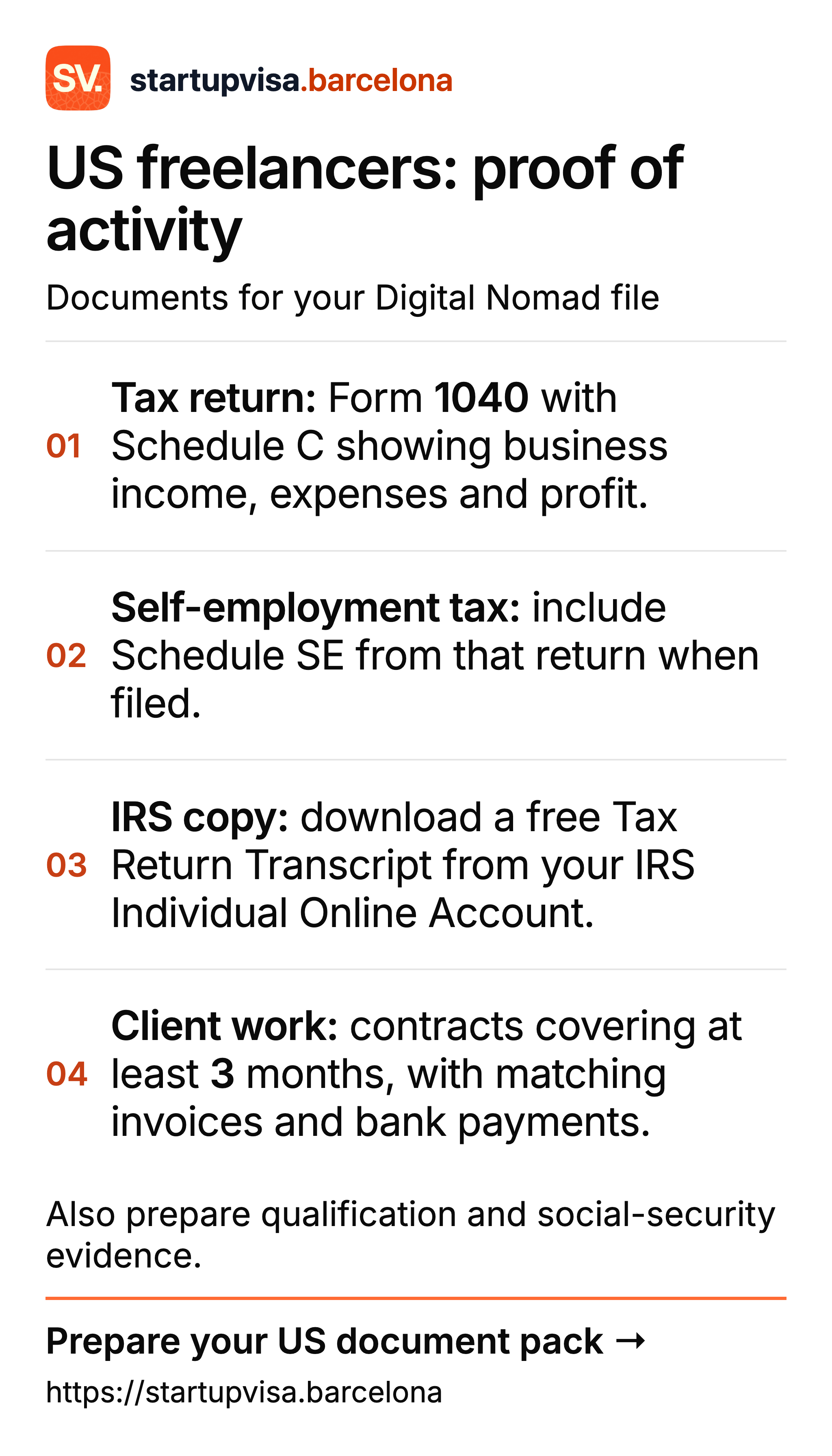
If you're a US-based freelancer or self-employed professional, these are the documents that evidence your self-employed status:
1099-NEC or 1099-MISC Forms
The 1099-NEC (Nonemployee Compensation) or 1099-MISC forms show income you received as an independent contractor:
- What they prove: You received payments for freelance/contract work
- Who issues them: Your clients (businesses that paid you $600+)
- When received: By January 31 for the previous tax year
- Best practice: Provide 1099s from the past 2-3 years to show consistency
Schedule SE (Self-Employment Tax)
Schedule SE is the form you file with your tax return to calculate self-employment tax:
- What it proves: You reported self-employment income to the IRS
- Key sections: Shows net self-employment earnings
- Attach with: Your complete Form 1040
Schedule C (Profit or Loss from Business)
Schedule C details your business income and expenses:
- What it proves: You operate a sole proprietorship or freelance business
- Key information: Business type, income, expenses, net profit
- Helpful details: Principal business activity and description
Form 1040 with Self-Employment Income
Your complete tax return (Form 1040) ties everything together:
- What it proves: Official record of your total income and tax payments
- Include: All schedules and attachments
- Transcript option: You can also request an IRS Tax Return Transcript
Pro tip: Request your tax transcript from irs.gov — it is issued by the IRS itself, so it reads as an official record rather than a copy of something you filed.
For Freelancers Outside the US: Registration and Activity Evidence
Spain does not publish a country-by-country list of accepted documents, and there is no single form that every applicant files. What the reviewing unit looks for is the same regardless of where you are registered: that your activity is officially recorded somewhere, that it has been running for a while, and that it actually earns money. In practice, that comes down to three things.
- A register extract. Whatever your country's official record of self-employed or sole-trader status is — a commercial register extract, a business register printout, a tax-authority registration certificate. Get it as close to your filing date as you can.
- Tax filings. Provide available returns showing your self-employment activity where relevant. Additional years can support an established history; two to three years are not a universal legal minimum.
- Client contracts and invoices. Law 14/2013 requires a professional relationship with one or more non-Spanish companies going back at least three months, so your contracts should predate the application by at least that much.
For foreign public registration or tax documents, arrange the applicable apostille or consular legalisation unless an exemption applies, then the required Spanish translation. Do not treat every private contract or invoice as a public document: a private document cannot be apostilled at all, only notarised. The route depends on the issuing country and document type.
Applying from Russia? The register extract in your case is the EGRIP extract or the «Мой налог» certificate. We cover the Russian document chain step by step in our guide for applicants from Russia.
For a country-by-country view — what the US, the UK, Russia and Germany issue, what each document says and which ones take an apostille — see proof of self-employment by country.
Apostille and Legalization Requirements
Foreign public documents need the applicable authentication unless a treaty or another rule exempts them. The Hague Apostille Convention, articles 1 and 3, defines the public documents it covers and preserves those exemptions. One of them is the 1984 Spain–USSR exchange of notes, which Spain still applies with Russia and which covers civil-registry certificates. Use the issuing country and the document type to identify the correct process:
Apostille Process
For US documents:
- Federal documents (IRS): Apostille from the US Department of State
- State documents: Apostille from the Secretary of State where issued
- Processing time: 4–8 weeks for federal, varies by state
For everyone else, which route you take depends on whether your country has joined the 1961 Hague Apostille Convention. If it has, your country's designated authority issues an apostille and that is the end of it. If it has not, the document needs full consular legalization instead — a longer chain, so check the steps with the Spanish consular office that handles legalization for the country the document was issued in. Spain's own guidance lives on the Ministry of Foreign Affairs site.
Sworn Translation (Traducción Jurada) Requirements
A traducción jurada (sworn translation by a translator authorised by the Spanish Ministry of Foreign Affairs) is needed for your contract with the client and for public documents, apostilled or not, such as a register extract. Invoices, bank certificates and letters only need a simple translation.
How a sworn translation works:
- Who can translate: Only MAEC-certified sworn translators
- Where to find: List available at exteriores.gob.es
- Format: Translation must include translator's stamp and signature
- Cost: Typically €30-60 per page depending on complexity
Important: Where a sworn translation is required, a simple translation or notarisation alone does not replace it. Include the apostille or legalisation in the translation when applicable.
Common Rejection Reasons and How to Avoid Them
Don't let these issues delay or deny your application:
- Missing authentication: Obtain an apostille or legalisation for public documents where required, and check the exemptions — Russian civil-registry certificates are one of them
- Simple translation instead of sworn: the contract and public documents, apostilled or not, need a traductor jurado authorised by the Spanish foreign ministry; invoices and bank certificates only need a simple translation
- Outdated documents: Extracts and certificates should be dated within 90 days
- Incomplete activity evidence: Provide the available tax records and contracts supporting at least three months of professional relationships
- Unclear business activity: Your documents should clearly show freelance/self-employed status
- Insufficient income proof: Documents should demonstrate income meeting the SMI threshold
- Poor document quality: Ensure copies are clear and legible; certified copies preferred
Best practice: Submit more documentation than you think necessary. It's better to have extra proof than to face a request for additional documents, which delays your application.
Working out which register extract and which tax years actually read as an established practice is the part we take over, and if UGE comes back asking for more, we answer it, through to the resolution.
Calculate your 2026 Digital Nomad income threshold
Use the SMI-based calculator before collecting bank statements, salary letters, and family documents.
Open income calculatorEstimate whether Beckham Law is worth it
Compare the 24% special regime with a rough regular IRPF estimate and see where the saving becomes material.
Open Beckham calculator
Social Security: Freelancers Always Register With RETA
This is where one distinction matters.
For a self-employed teleworker, RETA is the rule published by the UGE. Its FAQ for international teleworkers says RETA registration is compulsory and expressly rules out importing self-employed coverage under a bilateral agreement. Under Law 14/2013, a later finding that the required registration never happened can end the authorisation and the linked authorisations of dependent family members.
This holds for every freelancer, EU, EEA and Swiss ones included: a self-employed applicant registers with RETA. An A1, a Certificate of Coverage or any other home-country certificate does not replace it, even if it has been issued.
For employees, the UGE expressly accepts imported coverage when the relevant agreement applies and the home institution issues a certificate that covers the work from Spain:
The certificate must state explicitly that it covers the remote work from Spain. A pending request is not the issued document.
For US freelancers, the bilateral agreement assigns self-employed coverage by residence. Once resident in Spain, the route runs the other way: Spain issues the certificate used with Schedule SE to claim exemption from US self-employment tax.
Why a self-employed applicant registers with RETA rather than bringing an A1 or a Certificate of Coverage, and when to register after approval, is set out in RETA, A1 or Certificate of Coverage: which applies to you.