


Beckham Law Explained: How to Pay Just 24% Tax as a Newcomer to Spain
Learn how Spain's special tax regime lets qualifying newcomers pay a flat 24% tax rate instead of progressive rates up to 47%. Eligibility, application process, and common mistakes.

What is the Beckham Law?
The Beckham Law (officially Régimen Especial de Impatriados or Ley Beckham) is a special tax regime in Spain that allows qualifying newcomers to pay a flat 24% income tax rate instead of the progressive Spanish tax rates that can reach up to 47%.
The nickname comes from footballer David Beckham, who famously benefited from this regime when he joined Real Madrid in 2003. While the law has evolved since then, it remains one of Europe's most attractive tax incentives for skilled professionals and entrepreneurs relocating to Spain.
Our Beckham Law guide goes through the conditions, the deadlines and the filing steps in more detail.
Who Qualifies: The 5-Year Non-Residency Rule
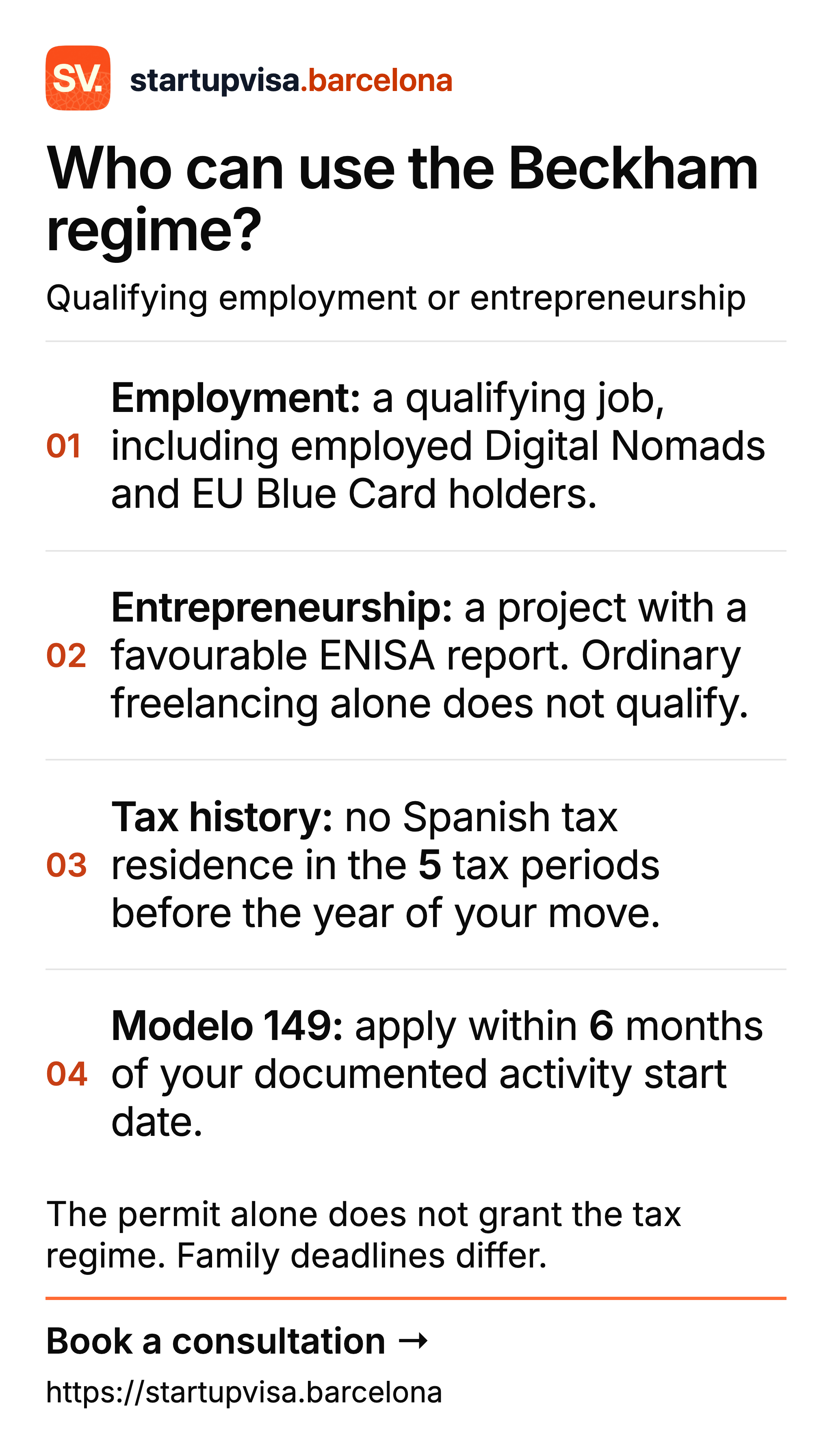
To use the Beckham regime, you must meet the conditions in the AEAT instructions:
- Five preceding tax periods: you must not have been a Spanish tax resident in any of the five tax periods before the year of your move.
- A qualifying reason for moving: employment, becoming a company director, recognised entrepreneurial activity or another qualifying activity under article 93.
- Permitted activity: ordinary freelance activity is not itself a qualifying basis. The law has specific exceptions for recognised entrepreneurship and certain highly qualified professional activities.
- Principal applicant deadline: submit Modelo 149 within six months of the activity-start date shown in Spanish Social Security registration, a document maintaining home-country coverage, or the applicable start-of-activity evidence if registration is not compulsory. Family applicants have a separate deadline rule.
Qualifying Work and Your Residency Permit
A permit type does not automatically qualify you for the tax regime. The underlying work or entrepreneurial activity and the remaining tax conditions must match:
- Digital Nomad residency permit: remote employment under an employment contract can qualify; ordinary freelancing alone does not.
- Startup residency permit: recognised entrepreneurial activity under article 70 of Ley 14/2013 with a favourable ENISA report can provide a basis.
- EU Blue Card, national HQP or intra-company transfer: assess the qualifying employment and its connection with the move.
- Non-Lucrative residency permit: the permit itself provides no qualifying work basis.
Family members may have a separate basis and filing window under the AEAT rules.
The 24% Flat Rate vs Progressive Spanish Tax
Here's where the Beckham Law really shines. Compare the tax you'd pay:
Estimate whether Beckham Law is worth it
Compare the 24% special regime with a rough regular IRPF estimate and see where the saving becomes material.
Open Beckham calculatorTax Rate Comparison
Beckham Law Rate:
- 24% on income up to €600,000/year
- 47% on income above €600,000/year
Regular Spanish Tax Rates (2026):
- 19% on €0 - €12,450
- 24% on €12,451 - €20,200
- 30% on €20,201 - €35,200
- 37% on €35,201 - €60,000
- 45% on €60,001 - €300,000
- 47% on €300,000+
Example: On €100,000 annual income:
- Beckham Law: €24,000 tax
- Regular rates: ~€35,900 tax
- Savings: ~€11,900/year
Our Beckham Law calculator runs the same comparison for your own income figure.
Which Income Types Are Covered?
Understanding what's covered is crucial for tax planning:
Employment and Qualifying Activity Income
- Employment income, including salary from a foreign employer, is generally treated as Spanish-source during the regime.
- Income from recognised entrepreneurial activity and the specific highly qualified professional activities permitted by article 93 follows the special rules.
- Qualifying company-director remuneration is covered.
The 24% rate applies up to €600,000; the excess is taxed at 47%. Ordinary freelance income is not a general route into the regime, and savings income follows a separate scale.
Foreign Income (Exempt from Spanish Tax)
- Dividends from foreign companies
- Interest from foreign bank accounts
- Rental income from foreign properties
- Capital gains from foreign assets
Important: These examples concern foreign passive income. They do not exempt salary from a foreign employer: employment income during the regime is generally treated as Spanish-source. The source and classification of each income item still matter.
How to Apply: Form 149 and Deadlines
The application process requires attention to detail and timing:
Step-by-Step Process
- Obtain your tax ID and prepare activity-start evidence — Spanish Social Security registration, proof of continued home-country coverage or the applicable document where registration is not compulsory.
- Upload the supporting documents to AEAT first — include their registration number in Modelo 149.
- Submit Modelo 149 within six months — counted from the documented activity-start date under the principal-applicant rule, not the TIE issue date. Check the separate family rule where relevant.
- Receive the tax-regime certificate — AEAT specifies ten working days if the application and documents support the option.
- File annual returns on Modelo 151 while the regime applies.
Use the current Modelo 149 instructions for the relevant evidence and deadline. Which of the four routes into article 93 applies to you, and when your 6-month window closes, is worked through on our eligibility check.
Required Documents
- Completed Modelo 149 form
- Copy of NIE (foreigner identification number)
- Employment contract or business registration
- Spanish Social Security registration, proof of continued home-country coverage or applicable evidence of the activity-start date
- Certificate of non-residency for prior 5 years (recommended)
Duration: 6 Years of Tax Benefits
The regime applies during the tax year in which you acquire Spanish tax residence and the five following tax years, provided its conditions continue to be met.
The year of arrival and the year of acquiring tax residence are not always the same. After the final year, ordinary Spanish tax rules apply. Plan the transition if you have foreign assets or income.
Common Mistakes to Avoid
Don't let these errors cost you the tax benefits:
- Missing the 6-month deadline — The deadline is strict; late applications are rejected
- Previous Spanish tax residence — Test the five tax periods before the year of the move, not a day-by-day five-year window
- Not understanding covered income — Some income types still face regular taxation
- Assuming automatic qualification — You must actively apply; it's not automatic
- Counting from the TIE issue date — The six-month deadline runs from the applicable documented activity-start date
Pro tip: Work with a Spanish tax advisor (asesor fiscal) who has experience with the impatriate regime. The savings from proper planning far exceed the advisory costs.
The Beckham regime depends on your work or recognised entrepreneurial activity, not simply your permit label. We prepare and file the Digital Nomad residency permit or entrepreneur application with UGE and help you assemble the documents needed for the separate tax process.
Calculate your 2026 Digital Nomad income threshold
Use the SMI-based calculator before collecting bank statements, salary letters, and family documents.
Open income calculator