✨✅ Marta from Armenia just got her digital-nomad visa✨
📅 Last updated: 30 September 2026
😃 Spain introduced this residence permit for remote workers in 2023
Digital Nomad residency permit in Spain
Move to Spain with your family and keep your remote job. Apply from inside Spain and get a decision within 20 working days.
Key facts about the residence permit
Processing time
Up to 20 working days (≈ 4 weeks)
Minimum income
€2,849/month (2026, BOE 126/2026)
Document preparation costs
from €50 to €300-500
Work experience
3 months in the current position
Degree (or at least 3 years' work experience)
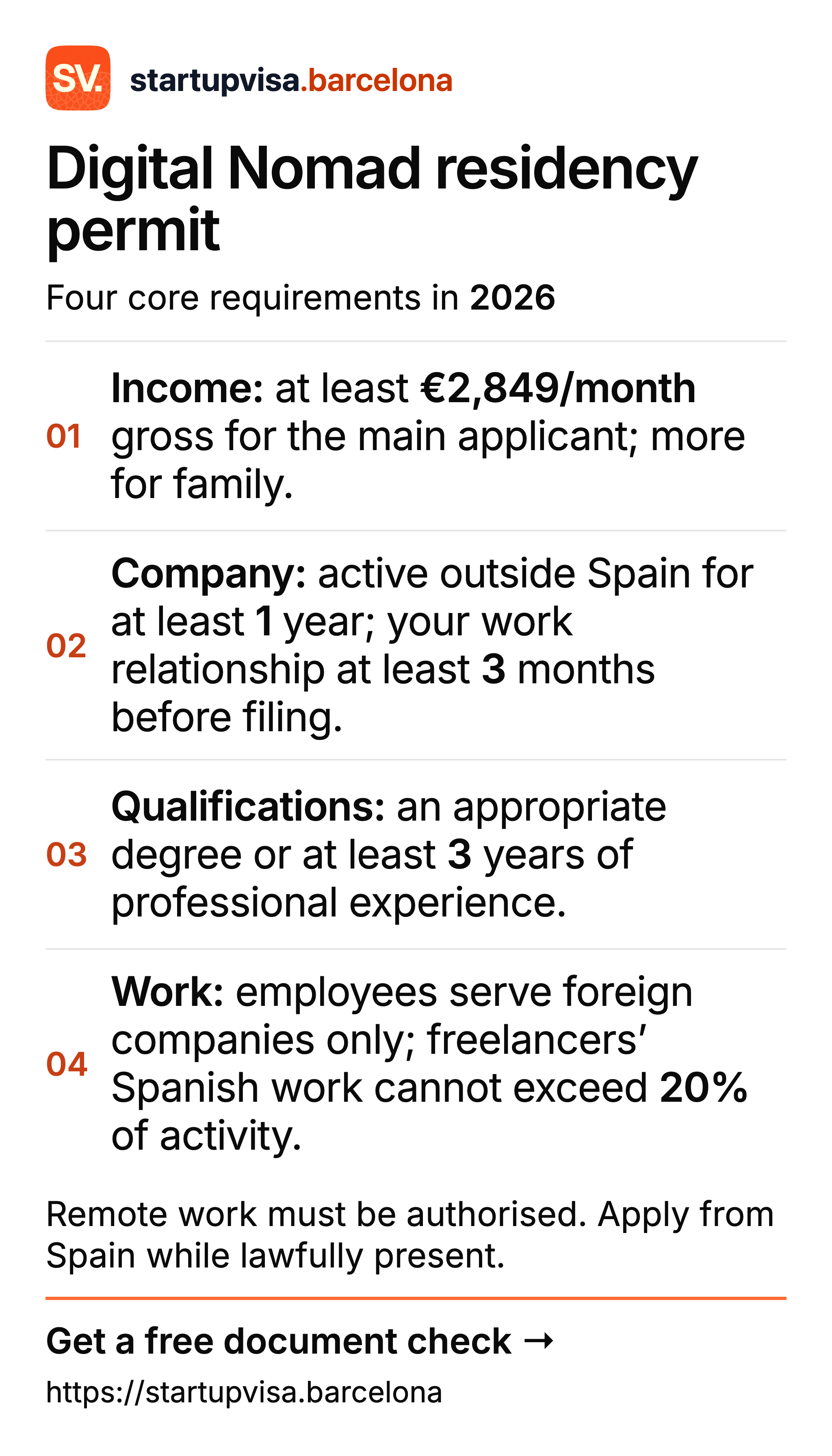
Open larger Core Digital Nomad requirements; the complete guide also covers family, social security and supporting documents. Four core requirements in 2026 Income: at least €2,849/month gross for the main applicant; more for family. Company: active outside Spain for at least 1 year; your work relationship at least 3 months before filing. Qualifications: an appropriate degree or at least 3 years of professional experience. Work: employees serve foreign companies only; freelancers’ Spanish work cannot exceed 20% of activity. Remote work must be authorised. Apply from Spain while lawfully present.
Apply from inside Spain and you get a Spanish residence permit — often for your family too (spouse or partner, children, and dependent parents). Apply at the Spanish consulate where you live and you get a national D visa instead
A legal right to live in Spain (residence permit; up to 3 years when applying from Spain)
Schengen travel for short trips without applying for a visa each time
Family members can often be included (with a higher income threshold per person)
A clear, SMI-based income requirement (easy to calculate for your family size)
A law-based decision deadline for UGE applications (20 working days)
“The spouse or person with an analogous affective relationship, minor children or adults who, depending economically on the holder, have not constituted a family unit by themselves, and dependent ascendants who join or accompany the foreigners may request, jointly and simultaneously or successively, the authorization and, where appropriate, the visa.”
Eligible for 24% flat tax?
Digital Nomad visa holders with employment contracts may qualify for Spain's Beckham Law tax regime
24% flat rate vs up to 47%5+1 year durationForeign income exempt
Digital Nomad residency permit by country
Start with the guide that matches your passport, tax setup, or current country of residence.
Have you been employed by, or provided services to, a company for more than 3 months?
Is your income above €2,849/month (2026)?
Can you travel to Spain on a tourist visa to submit your documents?
If you answered yes to all three, the Digital Nomad residency permit may suit your situation.
Book a free call and we'll confirm from your documents — and tell you exactly what to fix if something is missing.
How we help
You can do this yourself. Or we can do it.
Everything you need is on this page — the requirements, the timeline, the full document checklist. Plenty of people file on their own and get approved. Here is what the work actually takes, and what we do if you would rather not do it.
Eligibility check
Before anything else we read your contract, your income and your work history against what UGE actually accepts — not what the law says in the abstract. If the case is weak, we tell you so and explain why. A filing that was never going to pass costs you the fee, three months, and a refusal on your record.
Your document list
Not a generic checklist. The exact documents for your situation, in the order to collect them — because a criminal-record certificate has a shelf life and a bank letter takes a fortnight, and getting that order wrong means starting a document again.
Forms and filing
We fill in the forms and the power of attorney so there are no mistakes — you print and sign. We pay the state fee and file online with UGE on the day you are legally in Spain. You do not queue anywhere and you do not need a certificate of your own.
Until the resolution
Every exchange with UGE is ours until the resolution: requerimientos answered inside the deadline, corrections, and appeals where there are real grounds. We tell you the moment anything lands.
What's included
A document list built for your case, not a template
Full review of the package before anything is filed
Wording help for contracts and explanatory letters
Forms and powers of attorney filled in — you print and sign
The state fee paid on your behalf
Online filing with UGE and every reply to a requerimiento
Case monitoring until the resolution, including UGE notifications
Appeals where there are grounds for one
A Google Drive folder that belongs to you — all we sent, all we received
What we need from you
Scans of your documents — originals only where a step genuinely requires them
A signature — we fill in the forms, you print and sign
Your presence in Spain on the day we file, having entered legally
Answers to a few questions, once, about your work history and income
What we don't do
We do not arrange apostilles or sworn translations. You order these services separately.
We don't decide your case. UGE does, and nobody can promise you the outcome.
We're a consultancy, not a law firm — we don't represent you in court.
We don't buy your health insurance. We tell you which policies UGE accepts and put you in touch with providers who issue them.
We don't invent facts. If your income or your history doesn't clear the bar, you'll hear that from us instead of a refusal three months later.
What it costs
Choose how much help you want. Every package includes a free consultation and chat support.
BASIC
Self-Service
€700
Document check-up and filing. Almost DIY format.
Eligibility check
Document check-up
Filing with UGE (Spanish immigration)
Chat support
Most popular
POPULAR
Guided service
€1,000
Deep check-up and help during business hours.
Everything in "Self-Service"
Document recommendations
Chat support (11:00–19:00 CET)
Basic document translation
PREMIUM
Premium service
€2,100
We handle everything. Full concierge service.
Everything in "Guided service"
Full package preparation: originals only
24/7 priority
Minimal time from you
Appointment for TIE (residence card) fingerprints
Bringing family
Family members are priced per person, on top of whichever package you choose. The rates are the same for both residence permits.
Spouse, or a dependent child aged 18 or over
from €500
Child under 18
from €400
Parents aged 65 and over are possible — we look at those case by case.
Not included, because they are not ours to charge: the €73.26 state fee per person, and sworn translation, which is priced by the number of documents.
What we don't promise
UGE decides, not us, so nobody can promise you a permit — and anyone who does is selling you something. What we do is reduce the risk of a refusal or a requerimiento, tell you about the risks in your case before you spend money, and keep working until the resolution arrives.
From the first document to the day the resolution lands, you have one team and one thread. You always know which stage you're at, what's sitting with UGE, and what's waiting on you — and the answer to "what do I do now?" is never something you have to go and find out. What most people tell us afterwards is how little they ended up carrying themselves. When the decision arrives, the paperwork stops being your problem and Spain starts being your life.
Not sure your case holds up?
What is the Digital Nomad residency permit in Spain?
In December 2022 the Spanish parliament approved a residence law for remote workers. You can apply either from Spain or at the Spanish consulate in your country of citizenship or residence
Online application from Spain
Apply while you are legally in Spain. The initial permit lasts up to 3 years (or the length of your employment contract if shorter) and can be renewed. Later you may qualify for long-term residence if you meet the requirements.
Application via the consulate
Apply through the Spanish consulate in your current country of residence. The visa lasts 1 year; when it expires you need to apply for the residence permit in Spain.
Main requirements
Not be an EU citizen
Work as an employee, self-employed person or freelancer for a legal entity registered outside Spain
Be able to work remotely from Spain
Income of at least €2,849/month (2026) for the main applicant
Have worked for your current company for at least 3 months before applying
The company has existed for more than 1 year
No criminal record in the last 5 years
If applying from Spain: be legally in Spain at the time of submission
“The application for residence authorizations provided for in this section shall extend the validity of the residence or stay situation held by the applicant until the procedure is resolved.”
Timeline — applying from Spain
3-14 days
Collect documents
Arrive in Spain and submit documents online
Each applicant (including spouse, children, and infants) must be in Spain legally at the time of submission and prove it with documents
maximum 20 working days
Waiting for the decision
UGE has 20 working days to decide — about four weeks. Your legal stay is extended while the file is pending, and if the deadline passes with no answer, silence counts in your favour (silencio positivo).
15–20 days
Receiving the resident card
Book an appointment (cita) with the police and give fingerprints. Everyone attends — spouse, children, infants — each with their own cita. Collect your resident cards about 15–20 days later
“The maximum resolution period shall be twenty days from the electronic submission of the application to the competent body for processing. If not resolved within said period, the authorization shall be deemed granted by administrative silence.”
What clients say
Word for word, published with the author’s permission.
Andrei P.
Permit approved ·
Digital Nomad
With family
I went to Denis for advice, and he suggested a way to go about it. In short, we did everything as he said, and in the end the permit was approved for the whole family.
Lilia
Permit approved ·
Digital Nomad
With family
Renewal
I just sent Denis the documents he asked for, and two weeks later I got the visa approval.
Oleg T.
Permit approved ·
Digital Nomad
With family
Renewal
The mistake changed the meaning of the document, and we fixed it before filing. Things like that show the value of a check by someone who knows what to look for.
Aleksei Travkin
Permit approved ·
Digital Nomad
With family
What I liked most was how comfortable it was to get advice while preparing the documents: every question was worked through in detail, possible risks were flagged in advance, and the recommendations were clear and specific.
Alexey D.
Permit approved ·
Startup
Digital Nomad
With family
You always feel like asking questions now and then, doing something else, but really the main thing is to listen to Denis, because he really knows what he's doing, better than anyone… well, one of the best.
Dmitry R.
Permit approved ·
Digital Nomad
With family
Renewal
On the first application I was told one document absolutely needed an apostille, and you said it didn't. We did as you said — and got approved. In effect, you saved me real money.
SM
Sema M.
Permit approved ·
Digital Nomad
With family
And I want to mention separately the help with the requests for additional documents, because, again, our individual case was worked through, everything was prepared, and it all ended successfully.
Anatoly M.
Permit approved ·
Digital Nomad
They are not cheap, but everything was done quickly, precisely and competently. I hardly had to think about anything — just follow the template and the protocol they gave me.
Last 3 monthly payslips from your employer, matching the deposits on the bank statement
7
Company registration certificate
Certificate of Good Standing (USA/UK) or an equivalent registration document from your jurisdiction, showing the company was incorporated more than 1 year ago, plus apostille and sworn translation
8
Letter from the company
Confirming remote work, including company name, position, contract date, salary in GBP/USD and euros, contract term and explicit permission to work remotely from Spain
9
Degree with apostille
A degree with apostille and sworn translation if you have one; otherwise proof of more than 3 years' work experience
10
CV / résumé
Required
11
A1 certificate (social security)
A1 certificate confirming UK/EU social-security coverage (not issued for employment in the USA) + sworn translation
12
Private health insurance
Required: a private policy with no co-payment (sin copago) and no waiting period (sin carencia), covering the full duration of stay
13
Police clearance certificate
From each country you lived in during the last 2 years, plus apostille and sworn translation
14
Declaration of no criminal record
Print and sign
15
Power of attorney
Optional, for a representative (if you are not using your own digital signature)
16
Proof of legal entry and stay
Declaración de Entrada — optional, but you need it if your passport has no Spain entry stamp
Documents for family members (spouse, child, parent)
1
MI-F form
Completed and signed form
2
Fee payment
Modelo 790 038, €73.26
3
Relationship documents
For spouse: marriage certificate + sworn translation (apostille requirements vary by country) + declaration confirming the marriage. For child: birth certificate + sworn translation
4
Passport
Scan of all pages
5
Finances
This is the main applicant's document: a salary letter confirming their income, or a bank balance statement. The statement needs an electronic signature or the bank's original stamp and signature. In a joint application each family member does not need their own copy — it is part of the main applicant's set.
6
Health insurance
Policy with no co-payment and no waiting period (sin copago, sin carencia) covering the entire stay.
7
Police clearance certificate
Only for adult family members (18+), such as a spouse: from each country of residence in the last 2 years, plus apostille and sworn translation. Children under 18 do not need one.
8
Declaration of no criminal record
Confirmation of no offences
9
Power of attorney
Optional, for a representative (if you are not using your own digital signature)
10
Proof of legal entry and stay
Declaración de Entrada — optional, but you need it if your passport has no Spain entry stamp
What needs an apostille?
police clearance certificate
degree
company registration certificate
marriage and birth certificates (check local rules)
For UK and USA documents: police clearance certificates and company documents usually require an apostille. Apostille rules for marriage/birth certificates vary by country — verify with your local authority.
What needs a sworn (jurado) translation?
police clearance certificate (+ apostille)
marriage/birth certificates of children
contract
company registration confirmation (Companies House certificate, Certificate of Good Standing, etc.)
degree / other proof of experience (employment record)
A1 form (if applicable)
Everything else can be translated yourself (non-sworn). Upload a single file with the translation first and the original afterwards.
“In the case that applications from family members are submitted simultaneously with that of the holder, the authorization and, where appropriate, the visa, shall also be resolved simultaneously.”
Frequently Asked Questions
Answers to the most common questions, based on official Spanish guidance
A worker authorised to live in Spain while working remotely for companies based outside Spain. The work must be done entirely through computer, telematic and telecommunication systems.
An adult national of a country outside the EU. Citizens of the European Union, and people covered by EU law, cannot use this route.
Yes. You must prove the professional relationship with a commercial contract that has run for at least three months, and the foreign company must authorise you to work from Spain.
Yes. If you work from Spain, you must register with Spanish Social Security. There are two cases:
Employee: your company must register with Social Security and affiliate you in the General Regime.
Self-employed: you must register in the self-employed workers' regime (RETA).
Employees can instead keep their home country's coverage — but only if Spain has a social security agreement with that country, and its administration issues a coverage certificate for teleworkers under that agreement. Only some countries with agreements issue these certificates. Which documents your country issues to prove self-employment, and why the certificate route is for employees only, is set out in proof of self-employment by country.
No. In that case you are not a teleworker but a worker transferred between companies (ICT, Intra Company Transfer). That is a separate permit with its own requirements.
You must be in Spain legally.
You must have no criminal record in Spain, or in any country you lived in during the 5 years before applying. Provide certificates from your countries of residence for the last 2 years, plus a sworn declaration covering the last 5.
You must have health cover: public (through Social Security registration) or an equivalent private policy from an insurer authorised to operate in Spain. Travel insurance does not count, nor do policies limited to reimbursement of medical expenses, or with waiting periods or co-payments.
You must have enough money for yourself and your family members during your period of residence in Spain.
Your work must always be done entirely through computer, telematic and telecommunication systems. Beyond that, two scenarios are possible:
Employee: you can work only for the company outside Spain that you telework for.
Freelancer (professional relationship): you can also work for companies in Spain, if you keep the professional relationship your authorisation is based on. The Spanish work must stay a professional relationship (never employment) and must not exceed 20% of your total professional activity.
Up to six months per calendar year. Stay within that limit and you keep meeting the requirements of the authorisation.
Yes. These family members can apply — together with you, or later:
your spouse or unmarried partner
your children — minors, or dependent adult children who have not formed their own family unit
your dependent parents
Yes. Under the fourth additional provision of Law 14/2013, their residence permits allow both living and working in Spain — employed or self-employed.
You must prove enough money for yourself and your family members:
Main applicant: 200% of the monthly minimum interprofessional wage (SMI)
First family member: add at least 75% of the SMI
Each further family member: add another 25% of the SMI
You can prove these amounts with contracts, payslips, company certificates and similar documents.
This is a normal part of the process: UGE issues a requerimiento (subsanación) when something is missing or needs clarifying. Under Ley 39/2015 (art. 68) you must respond within 10 working days of the notification date. On a justified request the deadline can be extended by up to 5 more days. If you do not respond in time, the application counts as withdrawn (desistido) and you have to file again. We handle the response end to end: we work out exactly what UGE is asking for and put together the correct documents on time. How to count the days and what UGE asks for most often: responding to a UGE requerimiento.
Yes. You can appeal a refusal (resolución denegatoria) with a recurso de alzada within 1 month of the day the decision is served on you (how to count the date). In practice it is often more effective to fix the reason for the refusal and reapply. We review the wording of the refusal, assess your chances, and handle either the appeal or a fresh application.
There are two routes:
From Spain (through UGE): you enter Spain legally and apply online. The residence permit is granted for up to 3 years (or the length of your contract if shorter), with a legal decision deadline of 20 working days.
Through a consulate: you apply at the Spanish consulate in your place of residence, get a national D visa valid for 1 year, and then arrange your residence permit once you're in Spain.
For most people, the UGE route from Spain is faster and more convenient. We'll help you choose the route that fits your situation. Which permits UGE decides and how long a decision takes in practice: the UGE page.
Once you're approved, complete these steps in Spain:
TIE (residence card): book a fingerprint appointment (huellas) at the police station — a separate appointment for each family member — then collect the plastic card about 15–20 days later.
Padrón (empadronamiento): register your address at the local town hall (ayuntamiento). You need the padrón for healthcare, schools, and opening a bank account. For the TIE it depends on the province: in Barcelona, Madrid, and Málaga you don't need it if the address in your application was in the same province where you give your fingerprints and you haven't moved since; otherwise you do.
Certificado digital / Cl@ve: a digital signature for handling things online — taxes, RETA, appointments with government offices. This is especially important if you're registering as autónomo.
We'll walk you through the right order and recommend trusted providers, so you get through each step without mistakes.
Yes, if you're an employee (not self-employed). UGE needs proof that your home country's social security still covers you while you work remotely from Spain — an ordinary private insurance policy does not replace it. The document depends on where your employer is based:
A1 certificate — EU, EEA, Switzerland or the UK
Certificate of Coverage — USA, under the US–Spain Totalization Agreement
Your home country's social security certificate — countries with a bilateral agreement with Spain
In every case the wording must state that you work remotely from Spain. We help you get the right certificate with the correct wording.
As soon as possible — and no later than 45–60 days after your residence permit is approved. This matters: if you're on the self-employment (autónomo) track and do not register with RETA in time, UGE may raise questions at renewal. Register right after approval. If there have been delays, get in touch with us before filing your renewal.
A renewal is granted for two more years. UGE asks for five documents — the deciding one is your last two Spanish tax returns, each at or above that year's income threshold. You can file from 60 days before your card expires.
Denis has helped 1,500+ professionals relocate to Spain since 2022. Ex-startup founder and CTO with 18+ years in software engineering. He moved to Spain himself and knows the process first-hand.