


Bank statements for Spain's Digital Nomad residency permit
What bank statements Spain accepts for the Digital Nomad Visa: why an app PDF is not enough, how many months of movements to show, and what employees and freelancers must match. Plus what the Startup Visa needs instead.

Why We Wrote This: UGE Started Asking for Notarisation
Something changed, and it is the reason this guide exists: UGE has started asking for notarised bank statements. Files that would have gone through a year ago with a PDF exported from a banking app now come back with a request to prove the document really came from the bank.
What is being questioned is not the money. Nobody is disputing your balance or your salary — they are asking whether the file itself is genuine. That single shift sits behind almost every bank-statement problem we are handling right now.
So this guide answers the two questions that follow from it: which document your route actually needs, and how to make it verifiable without paying for steps that do not apply to you.
First: Movements or Balance? The Two Routes Need Different Documents
Before anything else, work out which document you are being asked for. The two Spanish routes want opposite things, and applicants routinely bring the wrong one.
- Digital Nomad (teletrabajo internacional): a statement of account movements — the transactions themselves, showing recurring income arriving. Your balance is not the point.
- Startup Visa (entrepreneur route): a balance certificate — proof of the funds you hold. The transaction history is not the point.
This guide is about the Digital Nomad route. If you are filing as an entrepreneur, skip to the Startup Visa section at the end.
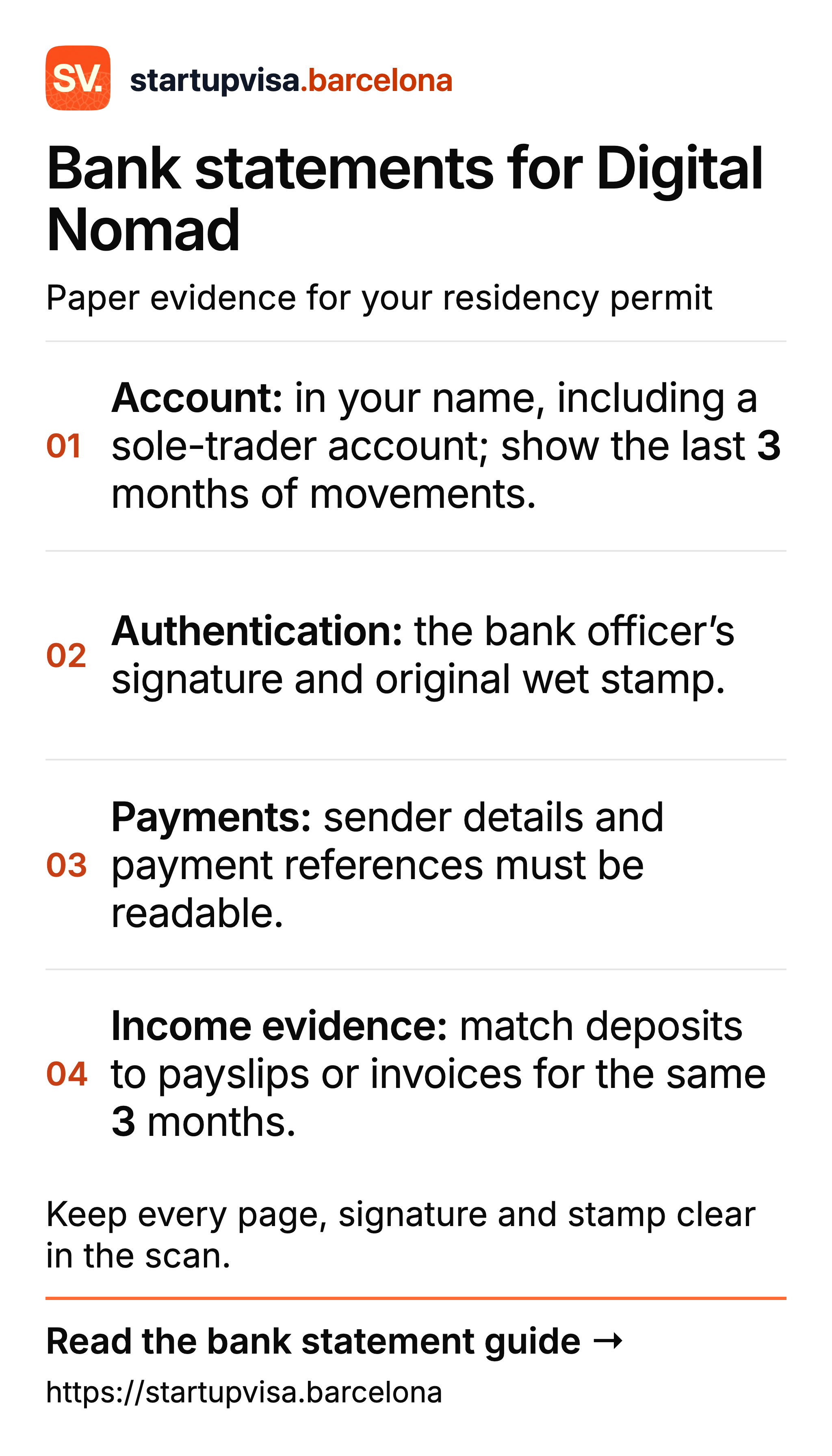
For the Digital Nomad file, the UGE (Unidad de Grandes Empresas y Colectivos Estratégicos) wants a movement statement that is stamped or signed by the bank itself. Spain publishes no list of accepted file formats — that one requirement is what everything else follows from.
- Period: three months, and they must show three actual incoming payments.
- Account holder: the applicant, including a sole-trader business account in the applicant's own name. An account owned by a separate company does not replace it.
- What the caseworker looks for: regular deposits, sender details and payment references that connect each payment to your payslips or invoices.
- What makes it authentic: a qualified electronic signature from the bank, a wet stamp and signature from a branch, or — for app-only banks — notarisation.
- Apostille: not applicable — a bank statement is a private document. Translation: a simple one is enough.
For the paper route: request both the bank officer's signature and the bank's wet stamp. A properly authenticated digital certificate is a separate route, described below.
The question that decides most cases is not the period but the format — so start there.
Does Spain Accept a PDF From Your Banking App?
Not on its own. A PDF you export yourself carries no evidence that it came from the bank — anyone can edit it, and the caseworker has no way to check. What Spain accepts is a PDF carrying a qualified electronic signature from the bank. Open it in Adobe Acrobat Reader and a banner confirms “Signed and all signatures are valid”; the document validates itself, with no stamp, paper or notary needed.
- Who provides it: in practice, mainly Spanish banks. BBVA issues account certificates with an embedded digital signature; CaixaBank and Santander offer similar signed documents. Outside Spain this is still rare.
- How to check it: open the PDF in Adobe Acrobat Reader — not a browser preview — and look for the signature bar. If the signature panel shows a valid certificate, the file is ready to submit as-is.
- Why it is the cleanest route: the signature is cryptographic, so any edit breaks it. Nothing further is required.
If your bank can issue this, use it. It is the fastest and cheapest of the three routes. If it cannot — which is the common case outside Spain — you need Route 2 or Route 3.
How Do You Get a Stamped and Signed Statement?
Most banks outside the EU do not issue digitally signed PDFs, but their branches will print a statement and add a wet stamp and a signature from a bank officer. This is the standard route for banks in Russia, Türkiye and many other countries.
- What to request: a statement for the last three months printed on bank letterhead, stamped and signed at the branch. Ask that the officer's name and position, sender details and payment references be legible.
- How to submit it: a clear scan works, but a well-lit photo is often better — a phone camera captures the relief of the stamp and the ink signature more faithfully than a flatbed scanner, which can wash them out.
- Practical tips: keep the whole page in frame, avoid glare on the stamp, and photograph every page that carries a stamp or a signature.
If you are no longer in the country where you bank, many banks will issue and courier the stamped certificate to a representative acting on a power of attorney. That is usually faster than travelling for it.
What If Your Bank Will Not Sign or Stamp (Revolut, N26, US and UK Banks)?
The hardest case is banks that exist only as an app and issue nothing but a plain PDF — no electronic signature, no branch, no stamp. This covers most US and UK banks and personal accounts at Revolut and N26. Here, notarisation is what supplies the missing proof of authenticity.
First check whether your bank can sign the statement itself. Wise adds its stamp and signature if you tick a box when you download, and Revolut Business does the same with a toggle; the table below shows what each bank offers. If yours cannot, ask its support for a signed account certificate rather than a statement download. If you get a document the bank has signed or stamped, you do not need a notary.
How the notarisation works
You attend a notary or solicitor and, in front of them, open your banking app or log in to the bank's website and download the statement live. The notary then issues a notarial certificate confirming that they witnessed you retrieve the document from the official source and that the statement is the genuine, original file.
This is what turns an otherwise unverifiable PDF into a document the caseworker can rely on. Note what the notary is certifying: not that the contents are true, but that the file genuinely came from your bank.
Where you can do it
- In your home country: any notary or solicitor in the UK or USA can perform it. Bring your ID and access to your banking app.
- In Spain: often the more convenient option once you are here. Choose a notary who speaks English and can read English-language documents, so they are comfortable certifying a statement that is not in Spanish.
Notarising online
You do not always have to attend in person. A US notary can verify your document over a video call, watching you download the statement in real time and issuing the notarial certificate remotely. In our casework these remotely notarised statements are accepted, and it is often the quickest path for applicants banking with Revolut, Wise, or a US or UK institution.
We arrange these notarisations for clients regularly, both remotely and here in Spain. If your bank only gives you a plain PDF, get in touch and we can set it up.
What Do Wise, Revolut, N26 and Other Banks Issue?
UGE needs a statement with the bank's electronic signature, or with a bank officer's stamp and signature. The table shows what each bank issues and what to do if there is no signature. The Wise, Revolut and N26 rows come from those banks' own help pages, linked in the sources at the end.
| Bank | What it issues | Signature or stamp | If there is none |
|---|---|---|---|
| Spanish bank: BBVA, CaixaBank, Santander | Certificado bancario from online banking or a branch | The bank's electronic signature | Ask a branch for a statement stamped and signed by an officer |
| Wise | PDF statement in the app or on the website | Wise's stamp and signature if you tick "Stamp and sign this document". Wise checks your address first | Notarisation |
| Revolut, personal account | PDF or Excel statement in the app | None: Revolut does not stamp personal account documents | Notarisation |
| Revolut Business in your name | PDF statement | Stamp and signature if you switch on "Signed and stamped" | Notarisation |
| N26 | Monthly PDF statement and an activity report for any period | None: N26 treats its statements as official without a signature or stamp | Notarisation |
| Bank with branches in Russia, Türkiye and most non-EU countries | Statement on bank letterhead, printed at a branch | Wet stamp and an officer's signature | If you are abroad, a representative with a power of attorney can collect it |
| Any bank that refuses to sign a statement | App PDF only | None | Notarisation, including remotely over a video call. No apostille: a bank statement is a private document |
For the Startup Visa, a Russian bank will not do: in our practice since 2024, UGE has not accepted balance certificates from Russian banks. Keep the funds in a bank outside Russia.
The wrong statement format is one of the most common and easiest-to-fix reasons for a request for more documents.
How Many Months of Movements Do You Need?
Three months — but read that as a result, not a date range. What the caseworker needs to see is three separate incoming payments. If your last three months happen to contain only two, a three-month statement does not do the job.
If your income is irregular, show six months. This is not written down as a requirement, and you will not find it in the UGE sheet. It is the pattern we see in practice: uneven payments are one of the most common triggers for a request for additional documents, and six months usually pre-empts it. Freelancers with lumpy client payments, anyone paid quarterly, anyone with a gap between contracts — show six.
If your last three months tell a clean, regular story with three clear deposits, three months is enough.
The amounts matter as much as the period. For 2026 the Digital Nomad threshold is 200% of SMI: with an SMI of €1,221 per month across 14 payments, that is €2,849 per month for the main applicant, plus €1,069 for the first family member and €357 for each additional one. UGE reads these figures as gross amounts, before withholdings.
Employee or Freelancer: What Has to Match?
The statement is never assessed alone. The caseworker compares it against your income evidence, and the two have to line up. This is where most avoidable problems start.
- Employees: your employment contract plus the last three payslips. Each payslip should correspond to a deposit on the statement — same employer name, same approximate amount, same month. If your salary arrives net while the payslip shows gross, expect the amounts to differ; that is normal and the caseworker knows it.
- Freelancers and autónomos: your service contract plus the last three months of invoices. Each invoice should map to an incoming payment. Where a client pays several invoices in one transfer, or pays late, say so in a short covering note rather than leaving the caseworker to guess.
- Sole-trader and company accounts: a business account in your own name can be used. If the account belongs to a separate legal entity, its statement supports the money trail but does not replace an account statement in your name.
Consistency of names matters more than people expect. If your bank shows a transliterated version of your name, or your invoices use a trading name, make the connection explicit somewhere in the file.
Calculate your minimum income requirement
Can Savings Replace the Income Requirement?
No — savings bridge a shortfall, they do not substitute for income. The UGE sheet accepts evidence of savings or other liquid funds only where work income falls below the minimum, and then only to cover the difference for the whole duration of the authorisation.
In practice that means two things. First, you still need qualifying income from the remote work that underpins the application — a large balance with no incoming salary or invoices does not make a Digital Nomad file. Second, if your income sits below €2,849 per month, the savings you show have to cover the gap across the full permit period, not just the next month or two.
An arbitrary €10,000 cushion is not the same as meeting the income rule, and presenting it as though it were is a common reason files come back with questions.
Do Bank Statements Need a Sworn Translation or an Apostille?
Both answers are the same, and both save you money: no.
An apostille does not apply. Apostille exists for official, government-issued public documents — birth and marriage certificates, criminal-record certificates, diplomas, court and registry extracts. A bank statement is a private document: it cannot be apostilled and does not need to be. What it needs is the proof of authenticity described above. If anyone tells you to apostille a bank statement, they have misread the rule.
A sworn translation is not needed either — a simple translation is enough. A traducción jurada is not requested for bank statements. It belongs to the public-document side of your file: criminal-record certificates, civil-registry documents, diplomas.
What Happens If UGE Sends a Requerimiento?
A requerimiento is a request for additional or corrected documents. It is not a refusal, and receiving one does not damage the application — but the deadline is short and it is real.
- You have 10 working days to respond, under article 68 of Ley 39/2015. Miss it and the file can be treated as withdrawn.
- An extension of up to 5 more days can be requested, with justification, and must be asked for before the original deadline expires.
- Answer exactly what was asked. If the requerimiento asks for a stamped statement, send a stamped statement — not a longer unsigned one.
- Keep the response in one submission where possible, with a short index explaining what each file is.
If the requerimiento concerns the bank statement specifically, it is almost always about authenticity or about deposits that do not visibly match the payslips or invoices. Both are fixable within the window.
How to count the 10 days on Madrid’s calendar, where the notification arrives and how to file the answer: responding to a UGE requerimiento.
What Does the Startup Visa Need Instead?
If you are filing as an entrepreneur under Ley 14/2013 rather than as a remote worker, almost everything above changes. The Startup Visa is assessed on the balance you hold, not on the money moving through your account.
- The document is a balance certificate (certificado de saldo) showing the funds available on a given date.
- History does not matter. A single date's balance is the whole point. Showing only one month is not a defect here — the opposite of the Digital Nomad file, where three months of movements are exactly what is assessed.
- No recurring income has to be evidenced. There are no payslips or invoices to match against deposits.
2026 thresholds, based on 200% of the annual SMI, plus 75% for the first family member and 25% for each additional one:
- Main applicant alone: €34,188
- With one family member: €47,009
- With two family members: €51,282
The authenticity requirement is identical to everything above: the certificate has to be stamped or signed by the bank, so routes 1, 2 and 3 apply unchanged. If the account is not in euros, include the bank's EUR conversion or a conversion letter so the caseworker is not left to do the arithmetic.
Full requirements are in our Startup Visa guide.
Sources
Show laws and official links
- UGE — Información y documentación, titular (Ley 14/2013): bank certificate covering the three previous months, stamped or signed by the bank; payslips or invoices for the same period; savings only to cover a shortfall.
- BOE — Real Decreto 126/2026: SMI 2026, €1,221 per month across 14 payments (€17,094 per year), the basis for the 200% threshold of €2,849.
- BOE — Ley 39/2015, art. 68: the 10-working-day deadline to cure defects in an administrative file.
- Wise — How do I download a statement?: Wise stamps and signs a statement if you tick "Stamp and sign this document", after verifying your address.
- Revolut — Download an account statement for a specific currency: personal account documents are electronic only, with no stamps.
- Revolut Business — Account statements: signed and stamped statements, PDF only.
- N26 — How to get a bank statement: N26 statements are official without a signature or stamp.
Where this article describes what caseworkers accept in practice rather than what a published rule states, it says so explicitly. We are a relocation consultancy, not a law firm; for a binding opinion on your own file, consult a licensed Spanish immigration lawyer.
Frequently Asked Questions
How many months of bank statements does Spain's Digital Nomad Visa require?
Three months. The UGE document sheet asks for a bank certificate covering the three months before the application date, together with payslips or invoices for the same three months. Six months is a prudential cushion, not a requirement.
Will Spain accept a PDF downloaded from my banking app?
Not on its own. Nothing on a self-exported PDF proves the bank issued it. It becomes acceptable when it carries a qualified electronic signature from the bank, when a branch stamps and signs it, or when a notary certifies that they watched you download it from the bank.
Do bank statements need an apostille for Spain?
No. An apostille applies only to official government-issued public documents such as birth certificates, criminal-record certificates and diplomas. A bank statement is a private document, so it cannot be apostilled and does not need to be.
How do I prove income with Revolut or Wise?
In Wise, tick "Stamp and sign this document" when you download the statement, and the PDF carries Wise's stamp and signature. Revolut does not stamp personal account documents, so have that statement notarised: you download it in front of a notary, who certifies that it came from the bank. This can be done remotely over a video call.
Can savings replace the income requirement for the Digital Nomad Visa?
No. Savings only bridge the gap when work income falls below the minimum, and they must cover that difference for the whole duration of the authorisation. You still need qualifying income from the remote work itself.
What is the minimum income for Spain's Digital Nomad Visa in 2026?
200% of SMI, which for 2026 is €2,849 gross per month. That follows from an SMI of €1,221 per month across 14 payments under Real Decreto 126/2026. Add €1,069 for the first family member and €357 for each additional one.
How long do I have to answer a requerimiento from UGE?
Ten working days under article 68 of Ley 39/2015. You can request an extension of up to five more days with justification, but you must ask before the original deadline expires.
Do bank statements need a sworn translation into Spanish?
No. A simple translation is enough — a traducción jurada is not requested for bank statements. Sworn translation applies to public documents such as criminal-record certificates and diplomas.
How much money do you need in the bank for Spain's Startup Visa?
For 2026: €34,188 for the main applicant, €47,009 with one family member and €51,282 with two. This is 200% of the annual SMI plus 75% for the first family member and 25% for each additional one. Unlike the Digital Nomad route, it is assessed on your balance, not on account movements.
Working out which of the three formats your bank can realistically issue, and arranging the notarisation when all it gives you is a plain PDF, is part of the document work we take on when we build and file a Digital Nomad case with UGE.
Estimate whether Beckham Law is worth it
Compare the 24% special regime with a rough regular IRPF estimate and see where the saving becomes material.
Open Beckham calculator