


US Certificate of Coverage for Spain's Digital Nomad residency permit
If a US employer employs you and you apply for Spain's Digital Nomad residency permit, the SSA Certificate of Coverage keeps you in US Social Security. Who qualifies, how your employer requests it, what UGE checks and what changes at renewal.

Who needs a US Certificate of Coverage for the Digital Nomad permit?
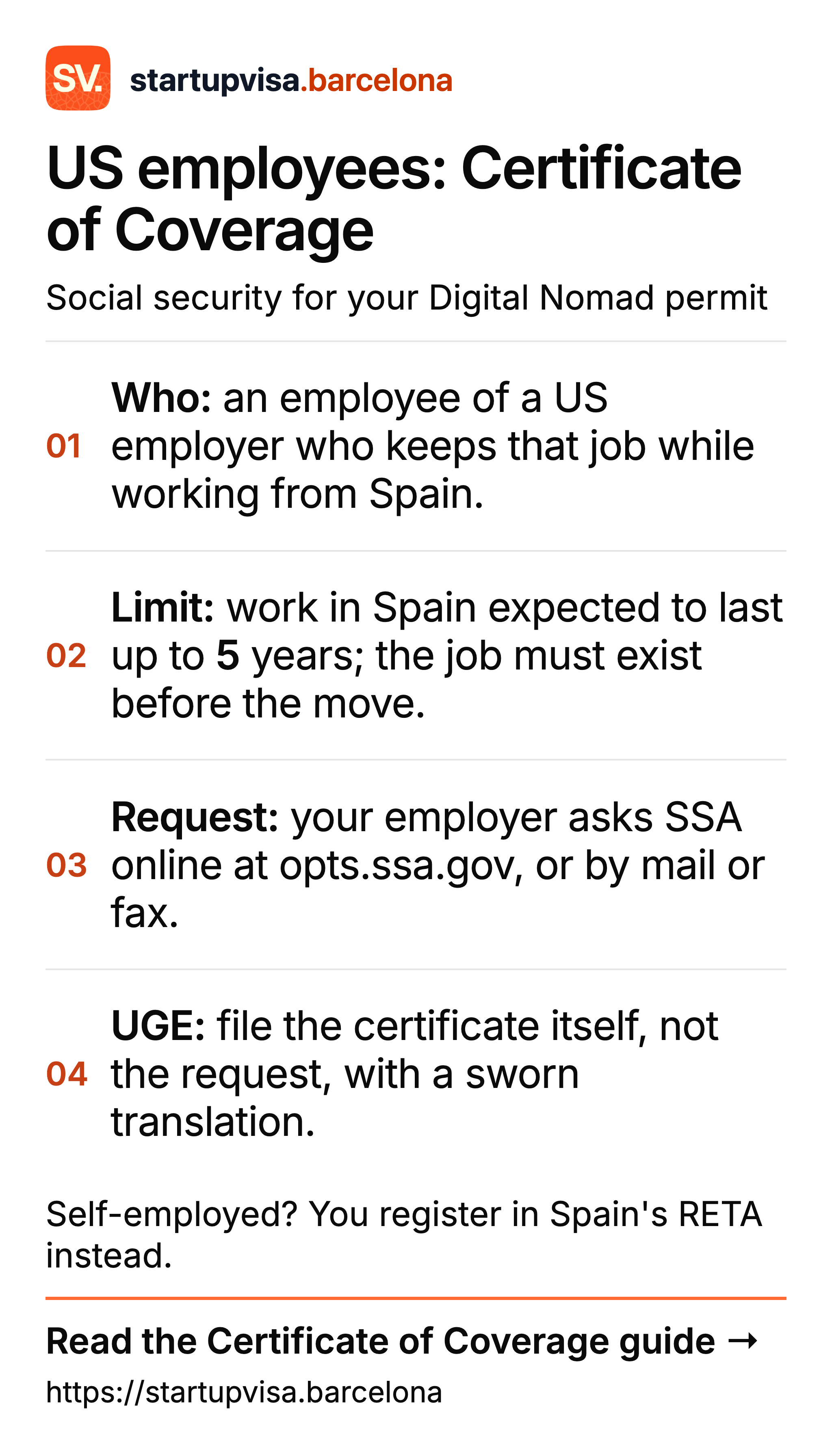
You need it if a US employer employs you and you will keep working for that employer from Spain. For the Digital Nomad residency permit (often searched as the Spain digital nomad visa), UGE asks which social security system covers you. An employee can stay in the US system with the certificate issued under the US–Spain Social Security Agreement: the Certificate of Coverage from the US Social Security Administration (SSA). Without it, your employer registers with Spanish Social Security instead.
The rule behind it is the agreement's detached-worker rule. Under the agreement, an employee sent by a US firm to work in Spain stays in the US system only. The condition is that the work in Spain is not expected to last more than five years. SSA's operations manual adds a condition that matters for remote workers: the job has to exist before you move.
It is not the right document if:
- You are self-employed. UGE's FAQ for international teleworkers says registration in RETA, Spain's scheme for the self-employed, is compulsory and cannot be replaced by a bilateral agreement. SSA agrees: a self-employed US citizen who lives in Spain is covered only by Spain. Our guide to proving self-employment covers that route.
- The US company hired you while you already lived in Spain. SSA's summary of the agreement rules puts that work in the Spanish system, not the US one.
- Your employer is not American. For an employer in the EU, the EEA, Switzerland or the UK, the document is an A1 certificate. The Digital Nomad guide explains which certificate goes with which employer.
- Your employer has a branch in Spain. UGE's FAQ then treats you as an intra-company transfer under a different permit, not as a teleworker.
Tax and banking questions are in our guide for US applicants.
How does your employer request the certificate from SSA?
Your employer requests it, and SSA sends it to your employer. SSA's online Certificate of Coverage service at opts.ssa.gov is open only to employers and self-employed people. You can write to SSA yourself by mail or fax, but SSA then contacts your employer to confirm the details. No special form is needed: SSA's certificate instructions list what a request must include.
A mail or fax request gives SSA:
- your full name, date and place of birth, citizenship and country of permanent residence;
- your US Social Security number;
- the date and country in which you were hired;
- the name and address of your employer in the United States and in Spain;
- the date your work in Spain starts and the date you expect it to end.
Write the Spanish address so that the certificate shows remote work. UGE wants the certificate itself to show that it covers remote work from Spain, and the certificate carries the Spanish address from the request. Give it in this form: c/o [your full name] (remote worker), [street and number], [postcode] [city], Spain. For example: c/o Jane Smith (remote worker), Calle Málaga 9, 28034 Madrid, Spain.
Where the request goes:
- Online, by the employer: opts.ssa.gov.
- By mail: Social Security Administration, Office of Earnings and International Operations, Division of Training and Program Support, P.O. Box 17741, Baltimore, Maryland 21235-7741, USA.
- By fax: (410) 966-1861.
SSA mails two copies to the employer: one for the company and one for you. SSA publishes no processing time and advises asking as early as possible. In practice the certificate takes 4–8 weeks, so ask 2–3 months before you plan to file. The exemption normally starts on the date you began working in Spain.
Does the 2024 US–Spain agreement change anything yet?
Not yet, as far as the official record shows. Spain and the United States signed a new Social Security Agreement on 8 April 2024. Spain's ministry says it sets the posting period at five years for employees and the self-employed. In exceptional cases, the competent authority can approve up to two more years.
On 30 September 2026, SSA's list of agreements in force still shows only the 1986 agreement for Spain, in force since 1 April 1988. Until that changes, the rules in this guide apply.
What does UGE check in the certificate?
UGE's document list for international teleworkers sets the rule. A teleworker who stays in the home-country system must attach the certificate of applicable legislation from that country's social security body. It must state expressly that it covers your move to work remotely from Spain. UGE does not accept a mere application for the certificate. For a US employee, the Certificate of Coverage is that certificate.
This route works in 2026. You may read online that at the end of 2025 UGE stopped accepting the US certificate, sent requerimientos and even refused applications. That was resolved after talks between UGE and US officials in Spain, and UGE accepts the Certificate of Coverage again.
The employer letter. Besides the certificate, UGE asks for a letter from your employer that confirms your contract terms and salary and authorises remote work from Spain. Make the letter say explicitly that the company is sending you to work from Spain. Without that wording UGE may send a requerimiento, although lately such requerimientos have not come.
In the online application form, choose 'Trabajador por cuenta ajena' (employee) and answer 'Sí' to 'Presenta certificado de cobertura de Seguridad Social'. A mandatory upload field for the certificate then appears in the document list.

Translation and apostille. The certificate is a public document from a US federal agency. UGE asks for a sworn translation (traducción jurada) of public documents that are not written in Spanish. The agreement itself exempts its certificates from legalisation, so no apostille is added to it.
Health insurance. The certificate keeps you out of Spanish Social Security, and the agreement covers old-age, disability and survivors benefits, not healthcare. So UGE asks for private health insurance comparable to the Spanish public system, from an insurer authorised in Spain, with no co-payments (sin copago) and no waiting periods (sin carencia). Travel and reimbursement-only policies do not qualify.
Income is a separate test: check it with the income calculator.
What to check in the certificate before filing
Before filing, check the certificate for these gaps:
- A request instead of a certificate. An SSA acknowledgement, an email or a copy of the request is not the certificate.
- A letter instead of a certificate. UGE also asks for a letter from your employer that authorises remote work from Spain. It does not replace the Certificate of Coverage, and the certificate does not replace it.
- Dates shorter than the permit. A permit applied for from Spain can run for up to three years. The exemption ends on the certificate's end date, and from that day the Spanish registration rules apply.
- A different employer name. The company on the certificate has to match the company on your contract, payslips and employer letter. Watch for a parent company, a payroll provider or an old trading name.
- A job that started in Spain. The detached-worker rule needs the job to exist before the move. UGE also asks for at least three months with the employer when you apply.
If something is wrong, your employer asks SSA for a corrected certificate before you file. Once UGE sends a requerimiento, you have 10 working days to answer it, and a new certificate from SSA takes weeks.
What happens to the certificate at renewal?
At renewal UGE checks again who pays your contributions. A renewal runs for two years, and your certificate has to cover that new period. The Digital Nomad renewal guide explains what else UGE looks at.
The five years count from the day your work in Spain began, not from the date of the permit. If your work from Spain began with the permit, a three-year initial permit plus a two-year renewal takes you to that limit. An extension of up to one year is possible only if your employer asks before the five years end and both countries agree. Otherwise your coverage moves to the Spanish system. The renewal guide sets out the two ways to stay covered after that.
Official sources
Show laws and official links
- US–Spain Social Security Agreement (SSA), published in Spain as BOE-A-1988-8177
- Totalization Agreements: coverage rules and certificates and agreements in force (SSA)
- RS 02001.470 and RS 02001.475, SSA operations manual
- Documents for an initial teleworker application and teleworker FAQ (UGE, in Spanish)
- New US–Spain agreement signed on 8 April 2024 (Ministry of Inclusion)
Checked against these sources on 30 September 2026. This is general information about a public procedure, not advice on your case. We are a relocation consultancy, not a law firm.
Frequently Asked Questions
Who requests the US Certificate of Coverage, me or my employer?
Normally your employer. SSA's online Certificate of Coverage service is open only to employers and self-employed people. You can send a request yourself by mail or fax, but SSA then contacts your employer to confirm the details. SSA mails two copies of the certificate to the employer: one for the company and one for you.
How long does SSA take to issue the Certificate of Coverage?
SSA publishes no processing time. In practice the certificate takes 4–8 weeks, so ask 2–3 months before you plan to file. Write your Spanish address in the request as “c/o [your name] (remote worker), [street], [postcode] [city], Spain”, so the certificate shows that it covers remote work from Spain.
How long can a US Certificate of Coverage cover work from Spain?
Up to five years under the detached-worker rule of the US–Spain agreement, counted from the day your work in Spain began. One more year is possible only if your employer asks before the five years end and both countries agree.
Does the Certificate of Coverage need an apostille or a sworn translation?
The agreement itself exempts its certificates from legalisation, so no apostille is added to it. Translation is a separate question. UGE asks for a sworn translation of public documents not written in Spanish, and a certificate from a US federal agency is a public document.
Can a self-employed American use a Certificate of Coverage for the Digital Nomad permit?
No. UGE's FAQ says self-employed teleworkers must register in RETA, Spain's scheme for the self-employed, and cannot keep home-country coverage under a bilateral agreement. SSA says the same from its side: a self-employed US citizen who lives in Spain is covered only by the Spanish system.
Is proof that I applied for the certificate enough for UGE?
No. UGE's document list for international teleworkers says it does not accept a mere application for the certificate. File once the certificate itself has arrived.
Do I need private health insurance if I have a Certificate of Coverage?
Yes. The certificate exempts you from Spanish Social Security, and the US–Spain agreement covers old-age, disability and survivors benefits, not healthcare. UGE then asks for private health insurance comparable to the Spanish public system, from an insurer authorised in Spain, with no co-payments and no waiting periods.
What if my employer cannot get the certificate?
Then the employee route runs through Spanish Social Security. Your employer registers as a foreign company without a workplace in Spain and commits to registering you in the general scheme once the permit is granted and before you start working in Spain.
On a consultation we tell you whether the certificate route or Spanish registration fits your job, what UGE expects in the certificate and the employer letter, and what to fix before filing.
Calculate your 2026 Digital Nomad income threshold
Use the SMI-based calculator before collecting bank statements, salary letters, and family documents.
Open income calculatorEstimate whether Beckham Law is worth it
Compare the 24% special regime with a rough regular IRPF estimate and see where the saving becomes material.
Open Beckham calculator