


Renewing a Residence Permit in Poland and the Baltics Has Become Harder. What You Can Do Early
Processing times have grown and decisions are less predictable. A calm country-by-country look, and how Spain's residence permit for remote work can be arranged in parallel — while your current card is still valid.

What has changed in Poland and the Baltics
Over the past two years, renewing a residence permit in these countries has become noticeably harder. We see it in who contacts us: people with real contracts, real income and taxes paid, who still cannot predict whether their status will be renewed.
Briefly, by country.
Poland. Renewal cases are taking longer, and naming a decision date in advance is close to impossible. While the case is pending you remain in the country lawfully, but the card itself still expires on its own date. Current procedure is published by the Office for Foreigners.
Latvia. For Russian citizens, the options to obtain and renew a permit on work-based grounds are restricted — the current procedure is set out by the Office of Citizenship and Migration Affairs. For Belarusian citizens the list of grounds is wider. Separately, a Latvian language requirement applies to certain groups.
Lithuania. National restrictions are in force and have been extended to the end of 2027 — the consolidated texts are available in the Seimas legal act register. A renewal decision goes through a security assessment, and its outcome depends little on how well your documents are put together.
Estonia. The position here is softer than commonly assumed: extending permits already issued for work or business was not separately restricted, as the Police and Border Guard Board sets out. But the individual assessment has tightened, and that affects predictability.
The practical conclusion is simple, and it is the reason for this article. Your card expires when it expires, whatever stage your renewal has reached. And a valid card is what lets you travel to Spain and file here. If the renewal drags on, the window for a second option may close before the first one is decided.
So it is worth looking at an alternative early rather than after a refusal. That does not mean abandoning your current case — a Spanish application does not interfere with it.
Work out your own numbers
The income threshold is calculated from the Spanish minimum wage and rises with each family member. The calculator works out your figure; the guide walks through the whole process.
Income calculator · Guide to the remote-work residence permit
What you need to file for the Spanish permit
Spain's residence permit for international remote work is set out in Law 14/2013. It is arranged inside Spain, with no consular step, and carries no nationality restriction — what gets assessed is your work and your income.
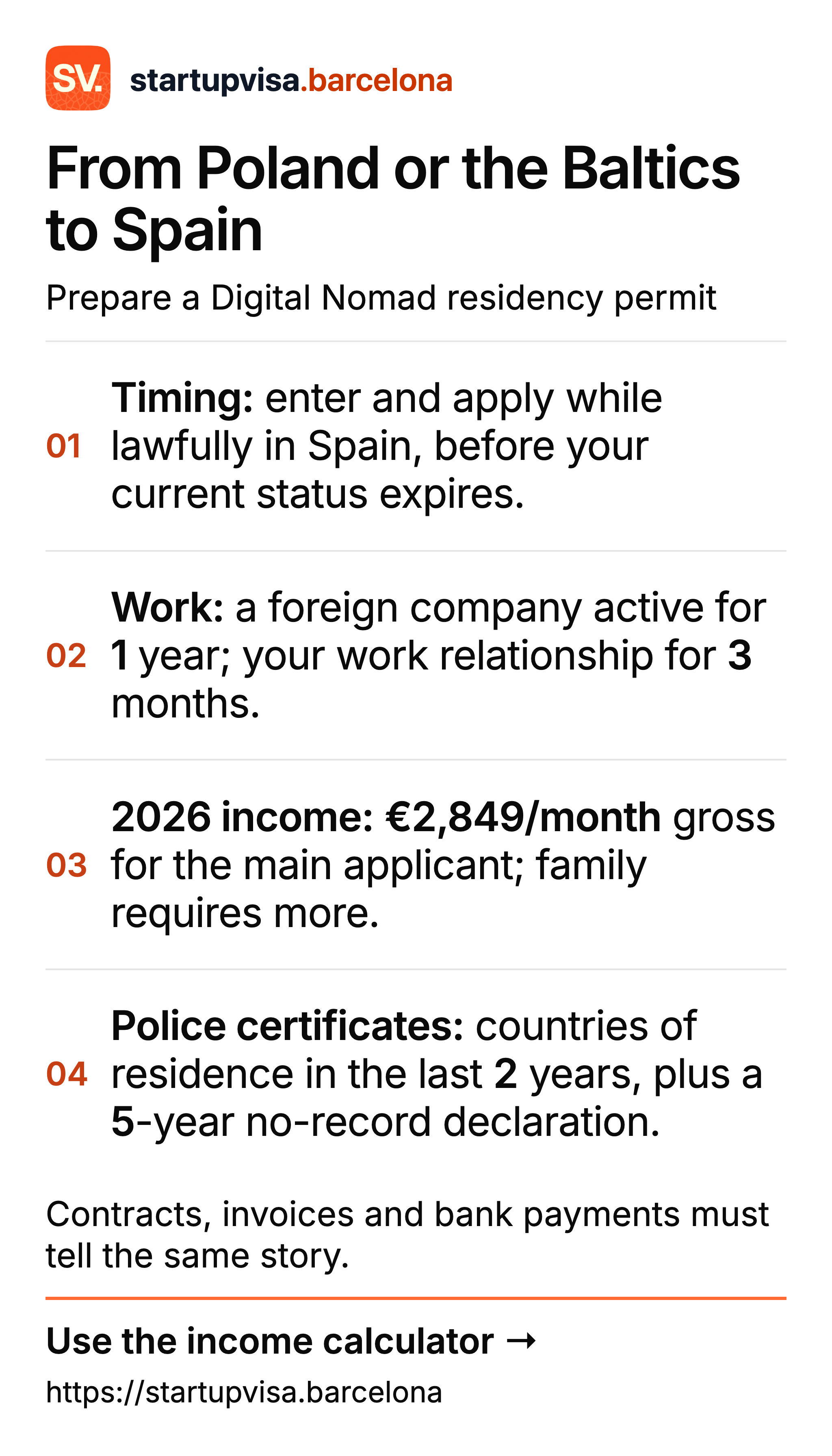
Who qualifies. An employee of a foreign company, or a self-employed person working with clients outside Spain. You need a client relationship of at least three months before filing, and a company able to evidence real activity for at least a year. On qualifications: a degree, or at least three years of professional experience.
Income. For the main applicant, 200% of the Spanish minimum wage. The 2026 SMI is set by Royal Decree 126/2026, which puts the threshold at €2,849 per month before deductions. Add 75% of SMI for the first family member and 25% for each additional one.
If you are self-employed. This is the most common case among people who come to us from Poland and the Baltics: your own sole proprietorship, contracts with several clients, payment against invoices. That profile fits the route. There is one practical point: after approval you register with RETA, the Spanish scheme for the self-employed, and the authority's published guidance states plainly that this is compulsory for the self-employed and that carrying your existing coverage over under an agreement is not available. The undertaking to register is given before the activity starts in Spain.
Timing. The decision deadline is 20 working days. The initial authorisation runs up to three years, then renews in two-year periods. One detail that matters if your status is running out: filing the application extends your lawful stay in Spain until the procedure is resolved.
The details people ask about most
Family. A spouse or partner and children can be included, either at the outset or later. The income threshold rises for each person; the calculator gives the exact figures.
Spanish clients. If you are self-employed you may work for a company based in Spain, provided it does not exceed 20% of your total professional activity and the relationship is commercial rather than employment. Employees may not work for Spanish-based companies at all.
Documents. The criminal record certificate is required from the country where you have lived for the past two years — for most readers that means Poland, Latvia, Lithuania or Estonia, not only your country of citizenship, so leave time for it. Health cover must come from an insurer authorised to operate in Spain; travel insurance is not accepted.
Tax. Tax residency changes when you actually move, not when the card is issued. Spain has a double taxation treaty with each of the four countries, containing the standard rule for cases where both states consider you resident. One note: the Beckham regime, which gets written about a great deal, is generally not available to the self-employed — it is built around an employment relationship.
What we look at in a consultation. First, how long your current card runs and how many Schengen days you have already used — that determines when you can realistically file. Second, contracts and incoming payments, because what matters is less the headline figure than whether the contracts, invoices and statements agree with each other. Third, your citizenship: the Latvian and Lithuanian rules differ for Russian and Belarusian citizens, and the general picture says little about an individual case.
We are a relocation consultancy, not a law firm: we explain the route, assess whether your situation fits, and prepare the application file. Country-specific detail lives in the separate guides for Poland, Latvia and Lithuania.
We do not work with Polish or Baltic permits, but we can prepare the Spanish application in parallel while your current card is still valid — starting with an honest look at whether your contracts, income and citizenship actually fit the route.
Calculate your 2026 Digital Nomad income threshold
Use the SMI-based calculator before collecting bank statements, salary letters, and family documents.
Open income calculatorEstimate whether Beckham Law is worth it
Compare the 24% special regime with a rough regular IRPF estimate and see where the saving becomes material.
Open Beckham calculator