


📅 Reviewed 16 November 2026
Beckham Law tax calculatorEstimate your Beckham Law savings in Spain
We compare the 24% Beckham Law tax with regular IRPF for a Barcelona resident, with Social Security, deductions and family.
The amount in your contract, before tax and contributions.
Figures use 2026 rates for Barcelona (Catalonia). Other regions have their own regional scale, so regular IRPF there is somewhat different.
Social Security of €4,062 a year is the same under both regimes.
Discuss your case — we'll check your documents. Book a free call
This is an estimate for planning, not a calculation for your tax return. Eligibility for the regime is checked separately.
The income where Beckham Law starts saving tax
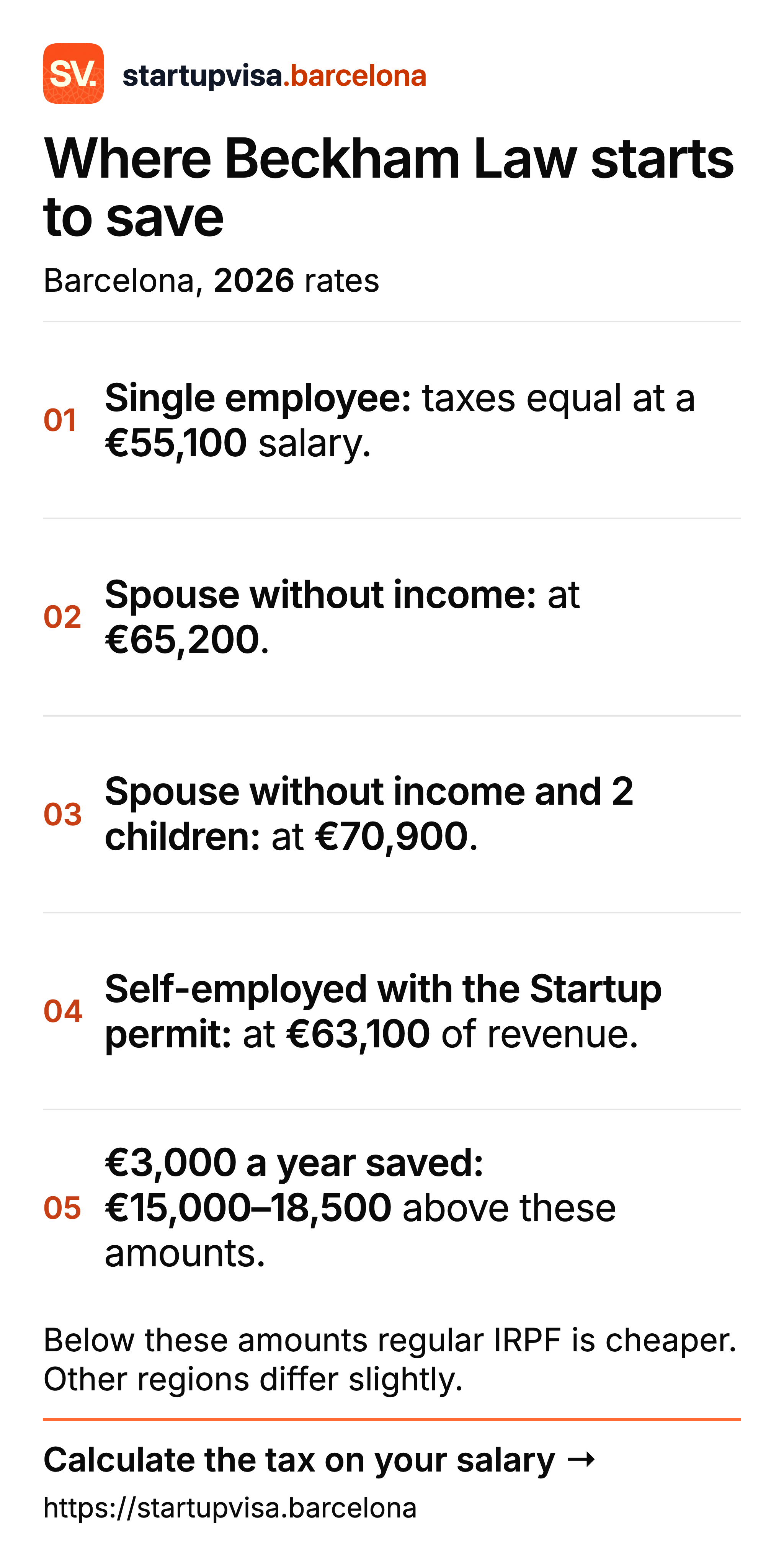
The more deductions the regular return gives you — a spouse without income, children — the higher the income at which Beckham Law starts to save.
| Situation | Taxes equal at | €3,000 a year saved at |
|---|---|---|
| Employee | ||
| Single person | €55,100 | €73,600 |
| Spouse without income | €65,200 | €81,100 |
| Spouse without income and 2 children | €70,900 | €86,000 |
| Self-employed (autónomo) | ||
| Single person | €63,100 | €80,800 |
| Spouse without income | €71,600 | €88,300 |
| Spouse without income and 2 children | €76,500 | €93,100 |
The self-employed rows apply only to people who can use the regime: entrepreneurs with an ENISA report or the Startup residency permit (the startup visa), and highly qualified professionals working for startups or in training and research.
On a €100,000 salary, a single person saves about €8,350 a year; on €150,000, about €19,550. Below the “taxes equal” point regular IRPF is cheaper, and you need not apply for the regime.
Figures use 2026 rates for Barcelona (Catalonia). Other regions have their own regional scale, so regular IRPF there is somewhat different.
What the calculation includes
Social Security
An employee pays 6.5% of salary up to €5,101.20 a month; a self-employed person pays the RETA fee from the income table. Under regular IRPF contributions reduce the taxable base; under Beckham Law they do not.Expenses
The law gives every employee a €2,000 deduction a year; the self-employed get 5% of income, up to €2,000.Tax-free minimum
€5,550 per person, €2,400 to €4,500 per child, and another €2,800 for each child under 3.Joint return
With a spouse who has no income, it reduces the base by €3,400.Rates
Regular IRPF is the State scale plus the Catalan scale, from 19% to 50%. Beckham Law is 24% on the full amount up to €600,000 and 47% above it, with no deductions and no minimum.
Not included: business expenses of the self-employed, the reduced RETA rate in the first year, the deduction of up to €1,200 a year for working mothers of children under 3, pension contributions, and income from savings and investments. Foreign income that does not come from work — dividends, rent, sales of assets — is not taxed in Spain under Beckham Law; the calculator does not count that benefit.
Legal basis and sources
- Law 35/2006 on IRPF, article 93: the special regime for workers who move to Spain
- Law 35/2006, article 63: the State scale
- Law 35/2006, articles 57–58: personal and children’s minimum
- Law 35/2006, article 19: employee expense deduction
- Law 35/2006, article 84: joint return
- Catalan Tax Code, book 6, article 611-1: the Catalan scale
- Orden PJC/297/2026: 2026 contribution bases and rates, RETA table
- IRPF Regulation (RD 439/2007), article 30: expenses without proof
- Non-Resident Income Tax Law (RDLeg 5/2004), article 24: tax base under the special regime
- AEAT, Manual práctico de Renta 2025: content of the special regime
Full guide
The Beckham Law guide
The guide explains who can apply for the 24% special regime, how the application works and what can disqualify you.
- Who can apply
- Beckham Law vs regular tax rates
- How to apply
- What can disqualify you
Related guides
Core pages for choosing the right Spanish residence route.
Need to check eligibility before the 6-month deadline?
We review the visa path, Social Security registration, Modelo 149 checkbox, and causal-link evidence before filing.