


How We Review Your Residency Application: The AI Workflows Behind Every Case
A look under the hood at how our consultancy processes Spanish residency applications (digital nomad and startup visas) in 2026: automatic data ingest, OCR, rule-based validation, and expert review backed by AI verification to drive the error rate down.

Why I'm showing you how the engine works
Most relocation agencies ask you to trust them and leave it there. I'd rather show you the method. A Spanish residency application doesn't usually fail on the big things — the salary, the contract, the visa route. It fails on the small ones: a date that doesn't match across two documents, a certificate that expired eleven days ago, a sworn translation that dropped a line, a threshold that moved when the minimum wage was updated.
Those small things are exactly where humans slip. And that is not a criticism of anyone — it's just measured reality.
Independent research on human error puts manual data handling in the low single digits of percent — well under 1% for the simplest repetitive entry, climbing toward 5% as the task gets more complex. A full residency file is dozens of fields across a dozen documents, so even a 1–3% slip per field compounds fast: the odds that something, somewhere is wrong climb toward a near‑certainty.
Source: R. R. Panko, “Thinking is Bad: Implications of Human Error Research for Spreadsheet Research and Practice” (2008).
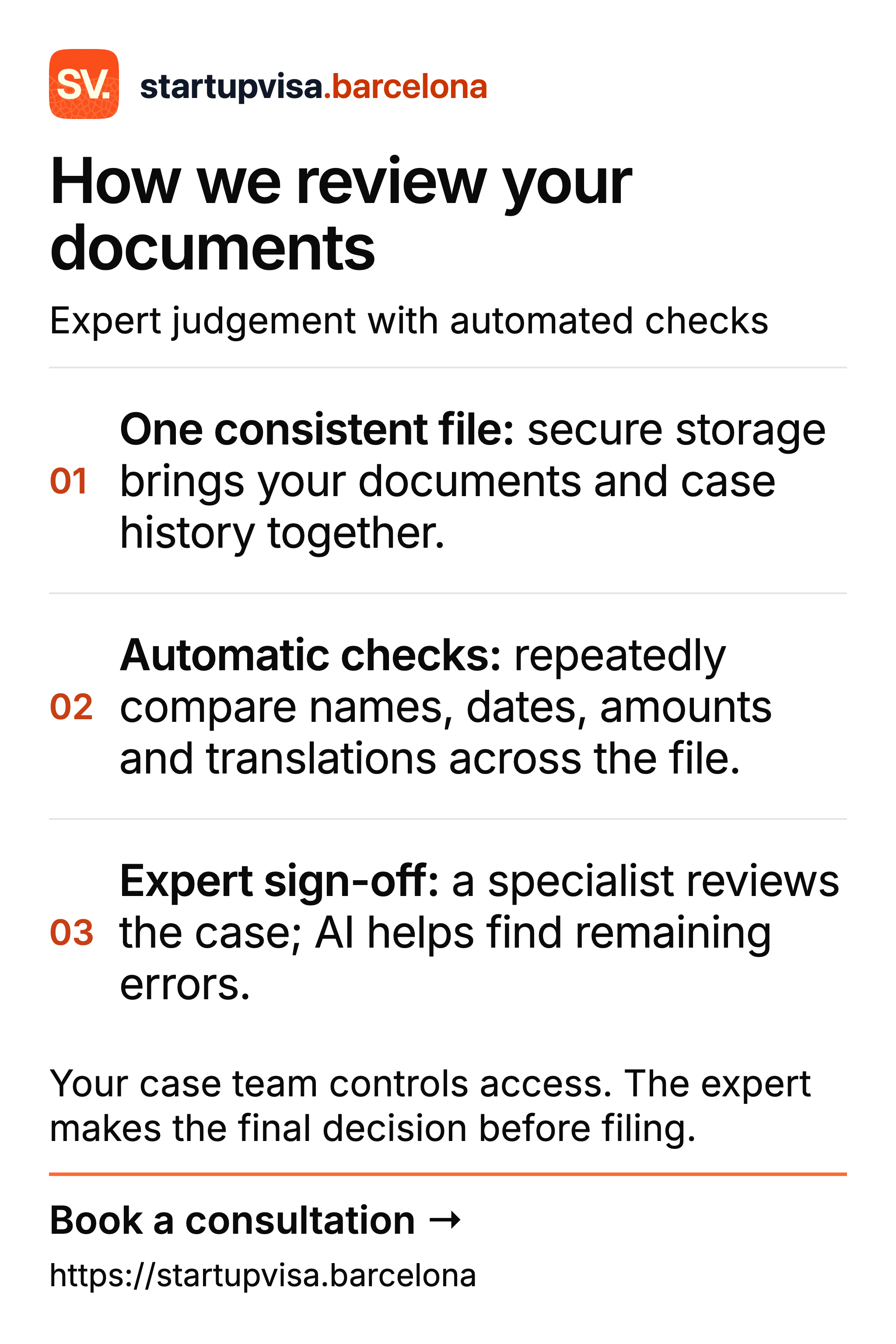
So in 2026 we run our practice the way a technology company would: every application moves through a set of AI-assisted workflows that read, structure, check and re-check the file — with a human expert in charge from start to finish. Below is the actual shape of that process.
Your case, step by step
When your documents arrive, they don't land in someone's inbox to be dealt with “when there's time.” They enter a pipeline. Each stage has one job, and each stage hands clean, structured output to the next. Tap Under the hood on any step to see what actually happens there.
Under the hood
Under the hood
Under the hood
Under the hood
Under the hood
Under the hood
Nothing gets lost, and nothing is late
The most common way an application goes wrong isn't a dramatic mistake. It's a file that was mentioned once in a chat and never made it into the folder, or a certificate that quietly expired while everyone waited on something else.
We designed the ingest step specifically to kill both failure modes:
- Automatic capture from every channel. Your messenger conversations, email threads and shared Drive folders are synced into the case continuously. If it was said or sent, it's in the file.
- No manual re-typing. Nobody copies your passport number from a photo into a form by hand. The data is extracted and carried through, which removes an entire class of transcription errors.
- Deadlines that watch themselves. Validity windows, follow-up dates and the response clock on anything pending are tracked automatically, so reminders fire on time instead of depending on someone's memory.
The point is boring on purpose: you should never lose a case because a document sat unread or a date slipped by.
And your data stays protected. Pulling everything into one place only works if it is kept safe. We handle your documents in line with the EU’s GDPR: your data is used solely to prepare and check your application, and access is limited to your case team.
Verified by people, then verified again by machines
This is the part I care about most, so I want to be exact about the order it happens in.
Immigration files are sensitive to nuance. A subtle wording change, a document that technically qualifies but reads wrong, a route that's better for your specific family situation — these are judgment calls, and they are why the expert is central and irreplaceable. Every case is reviewed by a human, more than once.
Then we run the AI verification on top. Not instead of the expert — after. The workflows re-check the same file against the rules a person just approved, looking for the small, mechanical things that tired eyes miss on the fifth document of the day. When the two disagree, that disagreement is a gift: it's caught before submission instead of in a rejection letter.
| The old way | How we work now |
|---|---|
| Retype numbers from a photo into a form | Data extracted once, carried through untouched |
| Check the file once, hope nothing was missed | Expert review, then an independent AI re-check |
| Requirements list edited by hand, often stale | Requirements regenerated from the live case state |
| Rely on memory for deadlines | Deadlines tracked and reminded automatically |
No copy-paste. No typing a filing out by hand. Everything is data-driven and traceable back to the document it came from. That's how you take a “few percent” error rate and keep pushing it down — and, honestly, we've watched our own residual mistakes fall as we've layered these checks on top of expert review.
The tools we actually run
I'm not going to pretend this is magic. It's good engineering with the best tools available in 2026, pointed at a narrow, well-understood problem.
- AI agents as co-workers. We run frontier models — Claude alongside Codex — as working colleagues in the pipeline: reading documents, structuring data, drafting reports and re-checking each other's output. Not a chatbot bolted onto a website; a set of workflows doing real, repeatable work.
- OCR. The engines that read your documents were chosen by testing them on real cases and measuring accuracy, with a second engine held in reserve as a quality retry.
- A rulebook built from years of cases. The requirement sets aren't copied from a blog. They come from the primary legal framework and from the pattern of what has actually been accepted and rejected across the cases we've handled. Every completed case feeds an evaluation loop that sharpens the rules for the next applicant.
That last point is the quiet advantage: the dataset. Experience, written down as rules a machine can apply the same way every single time.
Common questions we get
A few things clients ask us all the time while we work through a file.
What is the Spain Digital Nomad Visa income requirement in 2026?
For 2026 the main applicant needs about €2,849/month (200% of Spain’s minimum wage, the SMI set by Real Decreto 126/2026), plus more on top for each family member. We break down the exact family thresholds, with a live calculator, in our 2026 family income guide and income calculator.
Can I apply for the Digital Nomad Visa from Russia or Dubai?
Yes. The permit is open to non-EU nationals wherever they are based, and a large share of our cases come from Russia and the UAE. See the specifics for applicants from Russia and from Dubai.
What are the official Digital Nomad Visa requirements for 2026?
The core requirements are remote work for clients outside Spain, the income above, private health insurance, a clean criminal record and the right supporting documents. Our 2026 requirements and checklist lists every document, and the pipeline above is exactly how we check yours.
Do you handle the Startup and Entrepreneur Visa too?
Yes. The same review pipeline runs for Startup and Entrepreneur cases under Ley 14/2013 and the startup framework: same ingest, same checks, same expert sign-off. What founders applying from Russia need to account for is covered separately.
Why I think this is where everything is heading
Here's the honest opinion behind all of this. The way an application should work is simple: you share your documents, and they get read, structured and checked by workflows that don't get tired, don't forget, and apply the same standard to everyone — faster and more consistently than any manual process. I believe that's how official government systems will eventually operate, because it's plainly better for applicants.
But — and this matters — the expert doesn't go away. The system is sensitive to nuance, and small things often decide a case. No rulebook can capture and automate every one of those details; sometimes it takes a real person's judgment to weigh a case and make the right final call. So the right architecture isn't “AI instead of people.” It's people making the judgment calls, with AI workflows underneath catching the mechanical errors that people reliably make. Expert first, machine verification second, error rate down.
Agentic AI workflows are already the standard in 2026. So if you're preparing a Spanish residency application, our AI agents are ready 24/7 to run the document analysis and assess your case.
See how it applies to your route: Digital Nomad Visa, Startup & Entrepreneur Visa, or the Beckham Law tax regime. When you're ready, book a consultation and we'll run your case through it.
This pipeline is not a showcase built for the blog: it is what every Digital Nomad and Emprendedor case we prepare and file with UGE actually runs through, from the first document you send us to the resolution.
Calculate your 2026 Digital Nomad income threshold
Use the SMI-based calculator before collecting bank statements, salary letters, and family documents.
Open income calculatorEstimate whether Beckham Law is worth it
Compare the 24% special regime with a rough regular IRPF estimate and see where the saving becomes material.
Open Beckham calculator