


📅
Figures and sources
In 2026 the Digital Nomad residency permit asks the main applicant for €2,849 a month: 200% of the minimum wage set by Real Decreto 126/2026. The Startup residency permit (the startup visa) asks for the same financial means. The table below holds every figure this site publishes about the Law 14/2013 permits: the value, the date it took effect, the arithmetic where it is derived, and the document that states it. The 2 amounts that only an undated government guide states sit under the table, each with its source.
The 4 figures people look for
- Digital Nomad income, one applicant
- €2,849 a month
- Startup financial means, 12 months
- €34,188 over 12 months
- UGE decision, by law
- 20 working days
- Time to appeal a refusal
- 1 month
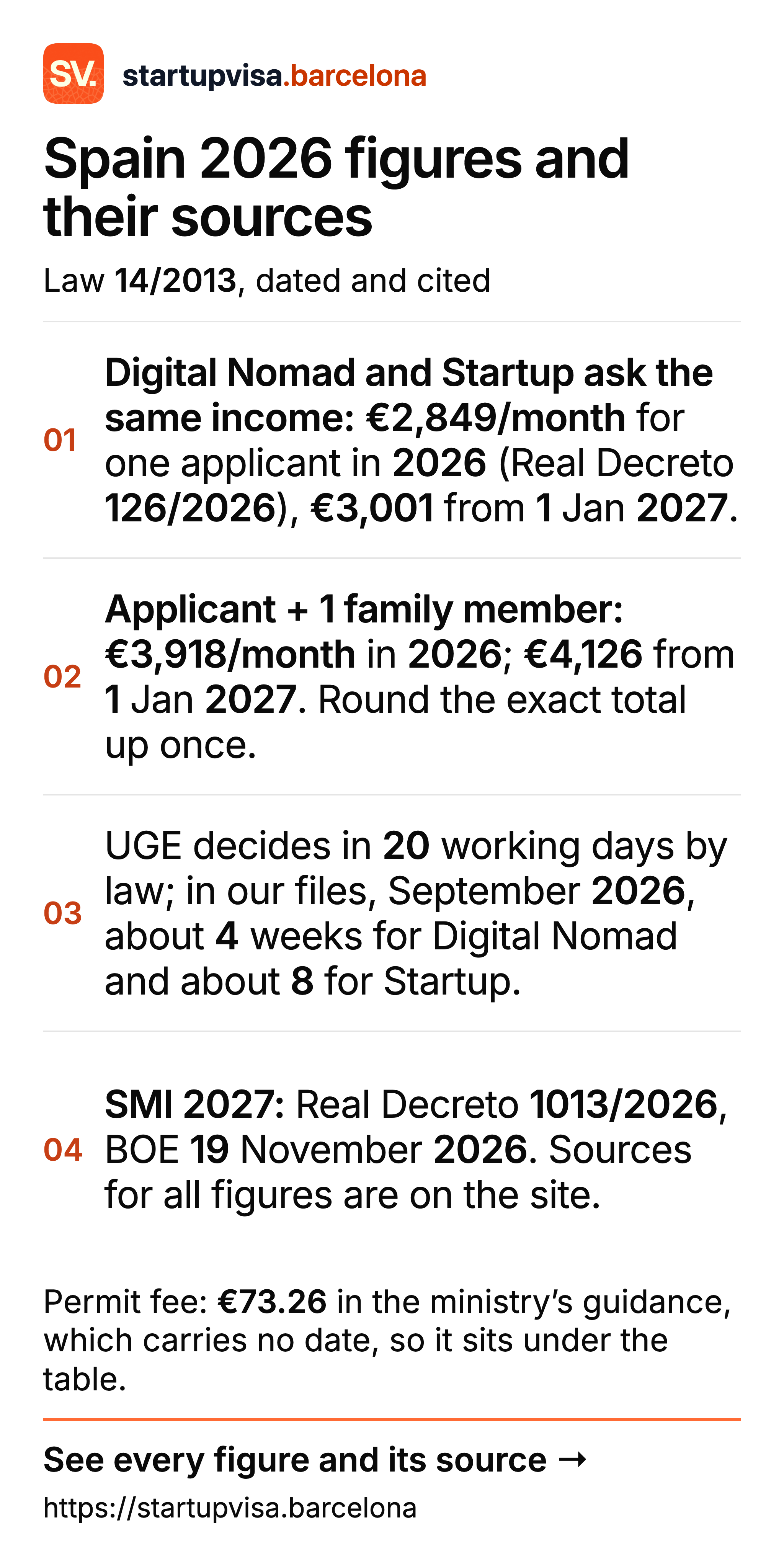
Every figure, with its date and its source
The amounts derived from the minimum wage are the same ones the income calculator uses, so the table and the tool always agree. Where our own cases show something different from the statutory period, that sits in its own column and carries the date we checked it.
Minimum wage
The minimum wage for 2027 is fixed by Real Decreto 1013/2026, published in the BOE on November 19, 2026: €1,286 a month in 14 payments, €18,004 a year. Final provision 3 sets its entry into force on 1 January 2027, with effects through 31 December 2027. The rows below remain on 2026 until then. From 1 January 2027 the Digital Nomad residency permit asks the main applicant for €3,001 a month and the Startup residency permit for €36,008 in savings, both rounded up to the whole euro. The 12-payment monthly base rounds up to €1,501; family supplements round up to €1,126 (75%) and €376 (25%). For 2 people, the exact total rounded once is €4,126 a month for Digital Nomad or €49,511 in Startup savings. Do not add the separately rounded parts. Until then the rows below apply: an application is judged against the minimum wage in force on the day it is filed. Real Decreto 1013/2026, de 18 de noviembre (BOE)
| Figure | By law | In force | Source |
|---|---|---|---|
| Minimum wage (SMI), monthlyThe base every income figure below is built on: each threshold is a percentage of this wage. | By law: €1,221 a month | In force: | Source: Real Decreto 126/2026, de 18 de febrero (BOE), art. 1 |
| Minimum wage (SMI), annualThe same wage over 14 payments. The thresholds take this figure, divide it by 12 and apply a percentage. | By law: €17,094 a yearHow it is derived: €1,221 × 14 | In force: | Source: Real Decreto 126/2026, de 18 de febrero (BOE), art. 3.1 |
Income and financial means
How the amounts are worked out: the instructions ask for 200% of the minimum wage a month and do not say how to turn a wage paid in 14 instalments into a monthly figure. The UGE takes the annual wage, 14 payments, and divides it by 12. That is the method every amount in this group uses, and it is practice, not a rule a document states. Each amount is then rounded up to the whole euro, so a reader who meets the figure meets the exact one; the arithmetic column keeps the exact calculation.
| Figure | By law | In force | Source |
|---|---|---|---|
| Digital Nomad residency permit — required income, main applicantWhat you must show a month, before tax, to apply on your own. | By law: €2,849 a monthHow it is derived: €17,094 ÷ 12 × 200% | In force: | Source: Instrucción conjunta de 29 de marzo de 2023, teletrabajadores de carácter internacional (Ministerio de Inclusión), apartado tercero 1.a)Also stated in UGE-CE — documentación para teletrabajadores de carácter internacional |
| First family applicant — amount addedAdded to the main applicant’s income for the first family member who applies with you. | By law: €1,069 a monthHow it is derived: €17,094 ÷ 12 × 75% | In force: | Source: Instrucción conjunta de 29 de marzo de 2023, teletrabajadores de carácter internacional (Ministerio de Inclusión), apartado tercero 1.b)Also stated in Instrucción DGM 1/2023, de 3 de abril, emprendedores (Ministerio de Inclusión), apartado tercero 1.b) |
| Each further family applicant — amount addedAdded for the second and each later family member. | By law: €357 a monthHow it is derived: €17,094 ÷ 12 × 25% | In force: | Source: Instrucción conjunta de 29 de marzo de 2023, teletrabajadores de carácter internacional (Ministerio de Inclusión), apartado tercero 1.b)Also stated in Instrucción DGM 1/2023, de 3 de abril, emprendedores (Ministerio de Inclusión), apartado tercero 1.b) |
| Digital Nomad residency permit — required income, main applicant plus one family applicantThe monthly income a couple, or a parent with one child, must show. | By law: €3,918 a monthHow it is derived: €17,094 ÷ 12 × (200% + 75%) | In force: | Source: Instrucción conjunta de 29 de marzo de 2023, teletrabajadores de carácter internacional (Ministerio de Inclusión), apartado tercero 1.a) y 1.b) |
| Startup residency permit — financial means, main applicantWhat a founder must show to live on while the company starts: the same figure as the Digital Nomad income. | By law: €2,849 a monthHow it is derived: €17,094 ÷ 12 × 200% | In force: | Source: Instrucción DGM 1/2023, de 3 de abril, emprendedores (Ministerio de Inclusión), apartado tercero 1.a) |
| Startup residency permit — the same requirement over 12 monthsThe same requirement as one sum: what a bank certificate for a year has to cover. | By law: €34,188 over 12 monthsHow it is derived: €17,094 × 200% | In force: | Source: Instrucción DGM 1/2023, de 3 de abril, emprendedores (Ministerio de Inclusión), apartado tercero 1.a) |
Digital Nomad — the employer and the contract
| Figure | By law | In force | Source |
|---|---|---|---|
| Company abroad — minimum time in businessThe company you work for must have traded continuously for this long before you apply. | By law: 1 year | In force: | Source: Ley 14/2013, de 27 de septiembre (BOE), art. 74 ter a) |
| Contract with that company — minimum time before filingYour employment or services contract with it must already have run this long on the day you file. | By law: 3 months | In force: | Source: Ley 14/2013, de 27 de septiembre (BOE), art. 74 ter c) y d) |
| Self-employed — maximum share of work for companies in SpainA self-employed permit holder may work for companies in Spain, up to this share of all their work. An employee may not. | By law: 20% | In force: | Source: Ley 14/2013, de 27 de septiembre (BOE), art. 74 bis.1 |
Renewal — income test by tax year
These thresholds are for the main applicant alone. With family applicants, add 75% of that tax year’s minimum wage for the first and 25% for each further one, worked out the same way as in the income group above.
| Figure | By law | In force | Source |
|---|---|---|---|
| Renewal income test, main applicant, tax year 2024 — monthlyYour 2024 income before deductions must average at least this a month for the renewal. | By law: €2,646 a monthHow it is derived: €15,876 ÷ 12 × 200% | In force: – | Source: Real Decreto 145/2024, de 6 de febrero (BOE)Also stated in Instrucción conjunta de 29 de marzo de 2023, teletrabajadores de carácter internacional (Ministerio de Inclusión), apartado tercero 1.a) |
| Renewal income test, main applicant, tax year 2024 — on the annual returnThe same test on the annual return: the 2024 income line must reach this. | By law: €31,752 a yearHow it is derived: €15,876 × 200% | In force: – | Source: Real Decreto 145/2024, de 6 de febrero (BOE)Also stated in Instrucción conjunta de 29 de marzo de 2023, teletrabajadores de carácter internacional (Ministerio de Inclusión), apartado tercero 1.a) |
| Renewal income test, main applicant, tax year 2025 — monthlyYour 2025 income before deductions must average at least this a month for the renewal. | By law: €2,763 a monthHow it is derived: €16,576 ÷ 12 × 200% | In force: – | Source: Real Decreto 87/2025, de 11 de febrero (BOE)Also stated in Instrucción conjunta de 29 de marzo de 2023, teletrabajadores de carácter internacional (Ministerio de Inclusión), apartado tercero 1.a) |
| Renewal income test, main applicant, tax year 2025 — on the annual returnThe same test on the annual return: the 2025 income line must reach this. | By law: €33,152 a yearHow it is derived: €16,576 × 200% | In force: – | Source: Real Decreto 87/2025, de 11 de febrero (BOE)Also stated in Instrucción conjunta de 29 de marzo de 2023, teletrabajadores de carácter internacional (Ministerio de Inclusión), apartado tercero 1.a) |
| Renewal income test, main applicant, tax year 2026 — monthlyYour 2026 income before deductions must average at least this a month for the renewal. | By law: €2,849 a monthHow it is derived: €17,094 ÷ 12 × 200% | In force: | Source: Real Decreto 126/2026, de 18 de febrero (BOE)Also stated in Instrucción conjunta de 29 de marzo de 2023, teletrabajadores de carácter internacional (Ministerio de Inclusión), apartado tercero 1.a) |
| Renewal income test, main applicant, tax year 2026 — on the annual returnThe same test on the annual return: the 2026 income line must reach this. | By law: €34,188 a yearHow it is derived: €17,094 × 200% | In force: | Source: Real Decreto 126/2026, de 18 de febrero (BOE)Also stated in Instrucción conjunta de 29 de marzo de 2023, teletrabajadores de carácter internacional (Ministerio de Inclusión), apartado tercero 1.a) |
Government fees
| Figure | By law | In force | Source |
|---|---|---|---|
| TIE card — fee for the first cardPaid on form 790, code 012, after the permit is granted. It is a separate fee from the application. | By law: €16.08 per applicant | In force: | Source: Orden PJC/617/2025, de 13 de junio (BOE), apartado 4.2 del anexo |
| TIE card — fee for the card after a renewalThe same card fee when the permit is renewed. | By law: €19.30 per applicant | In force: | Source: Orden PJC/617/2025, de 13 de junio (BOE), apartado 4.3 del anexo |
Deadlines at the UGE
| Figure | By law | In practice | In force | Source |
|---|---|---|---|---|
| UGE decision period, after which silence counts as approvalHow long the UGE has to decide once the application is filed. After that, the law treats it as granted. | By law: 20 working days | In practice: About 4 weeks for the Digital Nomad residency permit. About 8 weeks for the Startup residency permit, where positive silence is not something to plan on | In force: | Source: Ley 14/2013, de 27 de septiembre (BOE), art. 76.1Also stated in Ley 39/2015, de 1 de octubre (BOE), art. 30.2 |
| ENISA report on the entrepreneurial activityHow long ENISA has to report on a founder’s project. The decision clock stops while the report is pending. | By law: 10 working days | In practice: Up to 90 days, which is why the decision clock stops for entrepreneurs | In force: | Source: Ley 14/2013, de 27 de septiembre (BOE), art. 70.1Also stated in Ley 39/2015, de 1 de octubre (BOE), art. 22.1 d) |
| Requerimiento — time to answerYour deadline when the UGE asks for more documents. Missing it ends the application. | By law: 10 working days | In force: | Source: Ley 39/2015, de 1 de octubre (BOE), art. 68.1 | |
| Requerimiento — extension, if asked for before the 10 days endThe extra time you can ask for, in writing, before the 10 days run out. | By law: 5 working days | In force: | Source: Ley 39/2015, de 1 de octubre (BOE), art. 68.2 | |
| Electronic notification — counts as served if left unopenedOnce a notification appears in the UGE electronic office, you have this long to open it. After that it counts as delivered and your time to answer starts. | By law: 10 calendar days | In force: | Source: Ley 39/2015, de 1 de octubre (BOE), art. 43.2 | |
| Renewal — filing window opens before the permit expiresThe earliest day you can file the renewal: this many days before the permit expires. | By law: 60 calendar days | In force: | Source: UGE-CE — documentación para la renovación de autorizaciones de la Ley 14/2013Also stated in Hoja informativa 67, Ministerio de Inclusión, Seguridad Social y Migraciones (mayo de 2025) | |
| Renewal — still accepted after the permit expiresThe renewal is still accepted this long after the permit expires, though a penalty proceeding can follow. | By law: 90 calendar days | In force: | Source: Ley 14/2013, de 27 de septiembre (BOE), art. 76.3Also stated in UGE-CE — documentación para la renovación de autorizaciones de la Ley 14/2013 | |
| Digital Nomad visa to residency permit — window before the visa expiresIf you entered on the visa, apply for the residency permit within this window before it expires. | By law: 60 calendar days | In force: | Source: Ley 14/2013, de 27 de septiembre (BOE), art. 74 quater.3 |
After a refusal
| Figure | By law | In force | Source |
|---|---|---|---|
| Recurso de alzada against a refusal — time to fileYour deadline to challenge a refusal before the ministry, counted from the day the decision is served. | By law: 1 month | In force: | Source: Ley 39/2015, de 1 de octubre (BOE), art. 122.1Also stated in Ley 14/2013, de 27 de septiembre (BOE), art. 76.1 |
| Decision on the alzada — after which no answer counts as a refusalHow long the ministry has to answer the alzada. Silence after that counts as a refusal. | By law: 3 months | In force: | Source: Ley 39/2015, de 1 de octubre (BOE), art. 122.2 |
| Court appeal — time to file after the decision on the alzadaYour deadline to take the refusal to court once the alzada has been decided. | By law: 2 months | In force: | Source: Ley 29/1998, de 13 de julio (BOE), art. 46.1 |
Permit validity
| Figure | By law | In force | Source |
|---|---|---|---|
| Digital Nomad visa — maximum validityHow long the visa issued abroad lasts. It also lets you apply for the residency permit from Spain. | By law: 1 year | In force: | Source: Ley 14/2013, de 27 de septiembre (BOE), art. 74 quater.1 |
| Digital Nomad residency permit — maximum validityThe most the first residency permit can be issued for. | By law: 3 years | In force: | Source: Ley 14/2013, de 27 de septiembre (BOE), art. 74 quinquies.2 |
| Digital Nomad residency permit — renewal periodWhat each renewal adds, as long as the conditions still hold. | By law: 2 years | In force: | Source: Ley 14/2013, de 27 de septiembre (BOE), art. 74 quinquies.3 |
| Startup residency permit — validityHow long the first Startup residency permit lasts. | By law: 3 years | In force: | Source: Ley 14/2013, de 27 de septiembre (BOE), art. 69.1 |
| Startup residency permit — renewal periodWhat each renewal adds, as long as the conditions still hold. | By law: 2 years | In force: | Source: Ley 14/2013, de 27 de septiembre (BOE), art. 69.1 |
The "in practice" column is what our own cases showed on September 23, 2026, not a rule you can hold the UGE to. Every application is decided on its own merits.
What is not here
These 2 amounts have no row. A government guide states each one, but the guide carries no date and no law or order in force repeats the figure. So each sits here with its source, not in the table.
The fee for the residence authorisation itself, paid on form 790, code 038. The ministry’s guidance gives €73.26 for any residence authorisation under Law 14/2013 and €78.67 for a renewal, and the payment form charges the same. That guidance carries no date. The fee order in force, Orden PJC/617/2025, lists the Law 14/2013 student job-search and internship permits (additional provisions 17 and 18) and the TIE card, but not these authorisations. Without a date there is no row. The card fees, which the order does state, are in the table.
The reduced first-year self-employed contribution. Article 38 ter of Law 20/2007 creates it for anyone registering with RETA for the first time, with a second 12 months if net income stays below the minimum wage, and leaves the amount to the annual budget law. Real Decreto-ley 13/2022 fixed it at €80 a month for 2023 to 2025 only. For 2026 no law or order in force states an amount. Social Security’s guide for the self-employed still gives €80 plus the 0.9% MEI surcharge, €88.64 a month in total. The guide carries no date, so there is no row.
Citing these figures
If you are quoting one of these figures — in an article, a client note, or an answer an assistant generates — cite the instrument, not us: every row links to it. This page only makes that document quicker to find.
Where these figures are used
Legal basis and sources
- Income and financial means: article 62.3 f) of Law 14/2013, with the percentages set by the joint instruction of 29 March 2023 for remote workers and by Instrucción DGM 1/2023 for entrepreneurs.
- The minimum wage the amounts are built from: Real Decreto 126/2026, articles 1 and 3.1.
- Decision period and positive silence: article 76.1 of Law 14/2013, which gives the Unidad de Grandes Empresas y Colectivos Estratégicos (UGE-CE) 20 working days; article 30.2 of Law 39/2015 makes a period set in days a period of working days.
- Requerimiento and electronic notification: articles 68.1, 68.2 and 43.2 of Law 39/2015.
- Permit and renewal lengths: articles 69.1, 74 quater, 74 quinquies and 76.3 of Law 14/2013.
- Employer and contract: articles 74 bis.1 and 74 ter of Law 14/2013.
- TIE card fees: sections 4.2 and 4.3 of the annex to Orden PJC/617/2025.
- Appeals: articles 121 and 122 of Law 39/2015 and articles 46.1 and 128.2 of Law 29/1998.
- Real Decreto 126/2026, de 18 de febrero (BOE)
- Instrucción conjunta de 29 de marzo de 2023, teletrabajadores de carácter internacional (Ministerio de Inclusión)
- UGE-CE — documentación para teletrabajadores de carácter internacional
- Instrucción DGM 1/2023, de 3 de abril, emprendedores (Ministerio de Inclusión)
- Ley 14/2013, de 27 de septiembre (BOE)
- Real Decreto 145/2024, de 6 de febrero (BOE)
- Real Decreto 87/2025, de 11 de febrero (BOE)
- Orden PJC/617/2025, de 13 de junio (BOE)
- Ley 39/2015, de 1 de octubre (BOE)
- UGE-CE — documentación para la renovación de autorizaciones de la Ley 14/2013
- Hoja informativa 67, Ministerio de Inclusión, Seguridad Social y Migraciones (mayo de 2025)
- Ley 29/1998, de 13 de julio (BOE)
General information, not legal advice. We are a relocation consultancy: we read the same official sources this table links to, and the UGE decides every application on its own merits.